2017-05-30

Another cyber worm is loose on the Internet from the stock stolen from NSA

WannaCry was just one of the many exploit platforms that were stolen from NSA and now roaming on the Internet. EternalRocks worm is using same SMB vulnerabilities as WannaCry and three other attack vectors. It has not been weaponized yet, meaning that it does not have malevolent features added, but it has been infecting Internet-connected computers apparently since 3 of May.

The EternalRocks worm is an ideal platform that cyber attackers are using to prepare the target for more malicious effects. The behaviour of the work is as follows:

  • In the first stage, the worm uses SMB vulnerability to install itself on the computer. It also downloads .NET components and TOR browser together with C2 communications node.
  • Then it remains passive for 24 hours to avoid detection or analysis with sandboxing (sandboxing is used typically as virtual isolation between the Internet and closed networks to monitor downloaded the program for malevolent behaviour).
  • In the second stage, the worm uses TOR browser to download more executable files. Then it starts a random scan of opened SMB ports on the network it is connected. Once detecting a vulnerable target, it pushes the first stage exploitation to it.

The EternalRocks is such a clandestine worm that only with strong network visibility and monitoring tools, the traffic will be detected.

The military should be careful to ensure that their Internet-connected Microsoft operating systems are updated, and there is a strong monitoring and analysing function in place.

2017-05-07

A Structure of Military Enterprise


The paper provides Enterprise Architect with a business level view of the enterprise structures military have been using to generate, sustain and project the force.  It also presents an evolutionary model that the military enterprise has developed at the strategic level. The attempt is to provide military Enterprise Architects with a simple tool to assess current structure of the military enterprise and create viable options for the development at the strategic level. The paper uses critical realism to describe the changes in military enterprise structures and inductively build up a model that explains its evolution.

A Generic Model for War and Military Affairs

Since the birth of city-state, war has been a constant feature of civilization. Strategies have varied from capturing assets, gaining ransoms, annihilating the main force of adversary, destroying the basis for the economy, exhausting the source of power of the adversary, suppressing the political decision making, and transforming the public opinion.  The utilization of military force has been the main way in gaining these strategic goals.
Military force is not born in isolation. Nor is it yielded alone but in connection to both society and its governing body i.e. political leadership.  Clausewitz defined the triangle of political leadership, society, and military force pictured in Figure 1. 

Clausewitz observed the Napoleonic wars and their political nature stating that war is the continuation of politics by other means.  Lenin enforced this relationship creating a doctrine for the war of classes. He declared that the struggle continues at the political level when means of war are insufficient.  This was implemented successfully by Stalin after the II WW. 
The triad and their interrelationships are a source of power but also potential target to the adversary. Keys to winning a war have been equally the annihilation of military force, capture or suppression of political leadership, turning the public opinion of the society against the other two, or isolating either of the entities from the others.  

When two societies confront each other in some area of interest, there is a possibility that confrontation  escalates into a conflict . In conflict, a utilization of military force is possible since political leadership may not think of the outcome but only resolving the current conflict with available forces in Figure 2.  

This model is very military oriented since it does not illustrate the other lines of projecting power i.e. political, economy, and social.  The paper will add later these lines of force projection into the model.

A Model of Military Affairs

The basic capabilities  of a military organization in achieving the desired effect in a specific operating environment can be modelled as a value creation network pictured in Figure 3,

which is composed of force utilization, force support, and force generation functions.  These core functions may be defined further by readiness, deployment, projection, modernization, knowledge, engagement, manoeuvrability, or protection. The basic functions are further illustrated in Figure 4. 

The force utilization  means that force elements are deployed in operations to project the military force of destruction or threat of it. Use of force is the primary way to affect the adversary’s triadic structure. The avenues or dimensions in delivering the effect are typically space, air, maritime, land, electromagnetic and cyber.  Other dimensions in battlespace may also be resources and time. All the dimensions are at the physical level but changing the human behavior; the physical event needs to be translated into information, which needs to be received by a human to change his/her behavior.
  
The main tactical ways in force projection are engaging, maneuvering and protecting. Force elements maneuver to get into the reach of their targets and to be able to mass their combined arms effect. The engagement with vulnerable and crucial targets enough in the adversary systems may create network effect and suppress the entire system. Protection is to prevent own losses and take care of the society that military force is defending.
The force support means the ability to maintain constant intensity and duration of operational activity to achieve military objectives.  Force support extends out from the military organization using supply chains that may be global in reach, which means dependence on a larger network of value creation.  Supplies are required to sustain the fighting power. Disabled parts of force element need to be evacuated from the battlefield and restore their ability to fight. It is essential to evacuate wounded to sustain their health and prevent the loss of morale.

The force generation or production brings together doctrine, people, and equipment forming them into force elements with the desired capabilities. Force generation is a continuous process to develop operational and organizational concepts and then combines them with technologies, material, workforce, and limited resources to produce combat capability. 

Training of troops is most visible part of force generation. Armed Forces recruit their members from the society either by hiring voluntaries or acquiring them through compulsory military service.  By combining people with military equipment and doctrines, The Armed Forces provides basic and special competency for these members to be able to defend their society. Once achieving sufficient level, this capability is either provided to combatant commands as force elements or send to reserve for possible later need. Training needs to be refreshed before sending reserve force into operation. The force generation also includes the development of material based capabilities by acquiring and integrating them into existing force structures.

The interconnected system of military affairs is commanded and controlled by command structure that extends towards all stakeholders of the value-creating network with contracts and obligations based on legislation. The national law can control only domestic resources. Thus, coalition structures are needed to ensure the strategic durability for a nation.

Evolution of Dimensions in Military Conflict

The ways of engagement in the military conflict have evolved with the development of society described by Toffler (1980)  and technology described by Bousquet (2009) as pictured in Figure 5. 

There is a long history of military action beginning with the first documented battle of Mediggo in 1469 B.C.E. on land (and later, on the sea ) mainly projected by agricultural production which provided some urban centers. The main strategy for force projection in first wave society was massing of people with adequate weapons to annihilate the military force of the adversary.

When agricultural societies were migrated to industrial, their military forces evolved accordingly. Machines that could maneuver below the sea surface  and in the air  were invented and found useful in projecting military force. The new physical dimension of electromagnetic spectrum was invented and besides radio communications, was used in WW II to gain a tactical advantage in the Battle of Britain. Electronic Warfare (EW)  is the use of the entire electromagnetic spectrum and its properties to achieve a military advantage over one’s opponent or to reduce disadvantages. It consists of Electronic attack for engaging, Electronic protection for protective actions, and Electronic warfare support to search for, intercept, identify, and locate or localize sources of intentional and unintentional radiated electromagnetic (EM)  energy to immediate threat recognition, targeting, planning, and conduct of future operations. The main strategy for powerful force projection in second wave society was massing of material, weapons, and fire to annihilate adversary’s military force, suppress her government or harm the society that is providing it.


The third wave society invented Cyber  dimension, a human-made environment where digital information is processed, transmitted and stored. The cyber warfare includes actions by parties to penetrate another stakeholder’s computers or networks for causing damage or disruption . Information becomes the main enabler for massing effect in adversary’s systems attacking the “schwerpunkt” , centers of gravity. Information and cybernetics also become the force enabler that has the potential to transform military forces more than any single weapon system before.

Strategies used in military structuring

Military affairs and their structure can be studied considering their strategy and doctrine. The strategy of an organization is typically reflected in its processes, arranging the units and values . This paper is using a model developed by Jeanne Ross, Peter Weil and David Robertson (2006) to analyze operating methods of an organization.  The model defines two dimensions of process integration and process standardization. These two dimensions are divided into four areas of differentiation in process approach: Diversification, Replication, Coordination, and Unification as illustrated in Figure 6. 

Diversification strategy is evident for least standard and integrated organization, where smaller, independent forces are conducting operations independently in separate areas of operations. They are autonomous in their command, functions, support, and most of the development. The independent forces fight differently, support their action and develop their forces uniquely. These military organizations are usually hierarchically arranged, and value is created vertically along the lines of command.

Replication strategy is mainly after standardized processes that enhance operational efficiency. The goal is to execute standardized affairs faster than the adversary. Tactically and technically the forces are similar, but they are engaged in different areas of operation. The Commander in Chief is controlling the force production and support to maintain and improve standardization. There might be an inspector governance that is guiding the development of arms capabilities and force production.

Coordination strategy is mainly after integrated processes that aim to optimize the operational effect. Multi-arms effects are used to engage a joint adversary in each area of operation. Operational level autonomy of force utilization is enabled by coordinated efforts of force production and support. The Commander in Chief is coordinating the effort of each, possibly specific, force element. Coordination requires pervasive command and control system.

Unification strategy is a combination of integrated processes and standardized force elements. The strategy aims to maximize operational effect and effectivity through similar force elements all facing the same kind of adversaries in their area of operation. Processed are owned by the Commander in Chief or his staff and developed centrally. The maturity of processes enables deep specialization of units since they are always used in combined arms and joint manner.

The evolution of military structures

The following sections will elaborate the various stages in the evolution of military affairs and their structures.

Diversification as natural outcome of evolution

I hope none of you gentlemen is so foolish as to think that aeroplanes will be useful employed for reconnaissance from the air. There is only one way for a commander to get information by reconnaissance, and that is by the use of cavalry. 
General Sir Douglas Haig addressing the British Army Staff College in summer 1914.

The subsequent evolution of Services has diversified them naturally. First land or ground forces were created to protect agricultural assets. Then naval forces to protect critical channels for commerce. Lastly, air forces to utilize industrial technology for mobility and provide a strategic advantage over both land and naval forces. All three Services are fighting their war facing their equivalent adversary in land, sea, and air with only secondary support to each other.  Their force generation and development are different from the others, and they need specific support and supplies as illustrated in Figure 7.

The combined arms tactics for land forces was invented and developed by Gustavus II Adolphus (1594-1632), who maneuvered with a combination of infantry, cavalry, and artillery (fire, maneuver, and protection) preferring movement and attack over fortification. He dismantled the companies and regiments that troops were mobilized to “svadroons (500 soldiers)” and brigades (1500 troops), operational task forces. He was also the first to use replication strategy when he standardized each arm to have pistols with the same caliber, same size swords with cavalry, same caliber muskets with infantry and first light, mobile, regimental artillery with a controlled variation or their caliber. He also rearranged the generation and mobilization of his force were arranged with “rusthol” principle where a farm was to provide a rider, horse, and weapons when called and sustain this resource by providing new “Hakkapeliitta” if the previous died.  He was also the first to use mandatory armed/national service called “värnplikt” to recruit conscripts to fill the ranks (råd). 

The modern, multi-capable air force was created by Germany 1933 – 1939. With training support from the Soviet Union, German aircrew was generated already 1924 in the secret air bases. Due to the constraint resources and geopolitical reality, the Luftwaffe did not adapt Giulio Douhet’s ideas for strategic bombing but developed more close air support capabilities for ground operations and protection of the main land assets. This provided the Luftwaffe with more flexible air force capabilities that its future adversaries who were concentrating on building strategic bombing capabilities.

The command and control topology is following basic commander – staff structure illustrated in Figure 8. 

Commander in Chief (CIC) has all three Services directly under his command. Each Service is confronting their adversary in their dimensionally constrained area of operation. CIC is supported by Headquarters (HQ) providing strategic guidance, sufficient future views, expert advice, and administration support. There is little or no need for coordination between Services as they are independent at tactical and operational levels. Commanders of the Services are deciding both issues in current operations and building future capabilities. Moltke Sr. (1800-1891)  was one of the first to decentralize command and control of this line-staff organization by introducing mission. Instead of orders (Befelhle), he preferred instructions (Weisungen), that provided subordinate commanders with freedom of action as situation emerged.

The Diversified Services with only strategic level Commander in Chief structure is quite usual for peacetime armed enterprises. The Swedish Armed Forces were arranged this way before they launched the revolutionary transformation mid-1990s. Most of the European NATO countries had this structure until the transformation launched after the London Declaration 1990.   NATO updated its command structure 2003 still following these traditional lines.  USA forces were structured this way until 1983  when they established the unified combatant commands to execute operations in geographic areas of responsibility directly under the leadership of the president of US. The Services remained hidden in the structure renamed as component commands. 


Seeking for coordination and unification 

It takes all our Services together plus the industrial efforts of our Nation to win any major war. 
General Omar N. Bradley

The Luftwaffe also introduced first ground-to-air communication system that made a difference in Battle of France.  After the success in flanking French and English forces , the mobile, combined arms tactics of armored forces and close air support was used in Operation Barbarossa launched 1941 against the Soviet Union.

Armed forces have started to seek coordination and unification as their adversaries’ doctrine has evolved more towards combined arms tactics and joint operations. In particular areas of operation, no one Service can sustain their force or fight with success. The availability of combined arms/Branches/Services capabilities in operation opens more options for the commander to counter the enemy courses of action.  The Joint Force also allows the operational commander to pose multidimensional threats to the enemy as illustrated in Figure 9.

The co-operation between Air Force and Land Force that the Wehrmacht invented back in 1930’s was reinvented by NATO and launched as AirLandBattle in 1982.  It was coordinated engagement against all three echelons of Soviet armored troops at the same time. 

The principle of unified action become more important as an adversary was unifying their effects delivered by each Service. Also, the efforts of other than military forces were included into this unification. Thence unified action becomes “a comprehensive approach that synchronizes, coordinates, and when appropriate, integrates military operations with the activities of other governmental and nongovernmental organizations to achieve unity of effort“.  This gradually led to the introduction of Joint Combatant Command, which was organized for mission or theater particulars and had both Joint and Service components. The coordination of force utilization led into defining joint functions like Command and Control, Intelligence, Fires, movement and maneuver, protection, and sustainment. These functions were to integrate both each other and the operational and tactical functions of each component. 

The force generation and to some extent also force development still maintained its diversity and autonomy within each Service.  The Service becomes a provider of force elements, and their force utilization was controlled by component command subordinated to joint combatant command. The USA was amongst the first to adopt this structure in 1983.   The rest of NATO followed starting from 1990.

The tail of armed force has sometimes been reformed following the unification strategy. Namely, logistics has been considered like other Services, and standardization of supply and service functions have promised improved efficiency. Joint logistics was considered as art and science of planning and carrying out, by a joint force commander and staff, logistic operations to support the protection, movement, maneuver, firepower, and sustainment of operating forces of two or more Military Departments of the same nation. 

The organization of military force, after reforms in coordination and unification, may remind of the model presented in Figure 10. 

The commander in chief is supported by general staff headquarters to manage the strategic level. The actual operations are divided into missions or theaters under a Joint Combatant Command that utilizes force elements in coordination. 

The Services produce and develop force units and provide them for the Combatant Command. Logistics are mainly arranged under one unified Support Command that provides support to both diversified Services and cooperating Commands. 
The defense of UK after 2010 Defence Reform Review achieving its full operation on 1st April 2014 , is one representative of this model for defense affairs structure as illustrated in Figure 11. 

The Permanent Joint Headquarters and Directorate Special Forces are commanding all operations abroad. Force elements are provided by Navy, Army, Air and Joint Commands. Both combatant commands and development commands are enabled by enterprise services provided by Defence Business Services, Defence Infrastructure Organization, Science and Technology and Ministry of Defence Police. The supply chain required to provide armed forces is managed by Defence Equipment and Support and Information Systems and Services.

Optimizing the effect and consumption of resources

The operational space has evolved into three levels (physical, information and cognitive). Besides the military line of operation, there also available other ways to project power namely political, economic and social as illustrated in Figure 12. The dimensions of military operations at physical level have evolved to include space, air, maritime, land, electromagnetic, and cyber.  

As the complexity and spectrum of operations, where armed forces are utilized, is increasing and value chains, where armed forces are sourcing its resources, are becoming longer, the unification of fully joint force is often sought. NATO was calling this doctrine as “Comprehensive Approach” since 2011 when they updated the list of tasks in NATO Action Plan. 

Multiservice force provides symmetry of capabilities that protects against asymmetric threats of the enemy. Multiservice capabilities also provide the commander with a wider spectrum of options at a technical, tactical and operational level to strike against vulnerable points of enemy structure. This way commander has more courses of action to unify the effort in massing the effect at enemy centers of gravity.  The enterprise model for unified force is illustrated in Figure 13. 

The Combatant Commands, defined to project force in all four lines of operation, are provided with specialized units fitting best for a concept for operations. They are coordinating effects also delivered by multinational force units and both governmental and non-governmental organizations, not under the military command. The ISAF 2001-2014 was one of the widest spectrum and diversified operations in enabling the Afghan government to provide effective security across the country and develop new Afghan security force . At its height, it included troops from 51 nations. About same time UN was investing in Afghanistan around 291 million dollars via 30 different UNAMA projects to achieve sustainable and profitable development through local communities.  Besides of this, there were UNHCR, Red Cross, Red Crescent, and many other organizations effort in place.

The force generation still includes dimensional specific features in troops training but for example simulation training is growingly provided in combined arms context. There is also a tendency to expose troops to combined arms live fire before sending them to operations or reserve. Some countries, like Sweden, have merged their Service Commands to Joint Commands for operations, production and support. 

The supply chain that is needed to support both force generation and force utilization is a global interdependent value chain.  The demands for more accurate support are meeting more constrained and degraded logistics resources. The solution is globally integrated Joint Logistics Enterprise . The supply chain composed of modularized supply nodes  that are connected by information and transportation networks. This Globally Integrated Logistics can provide support agiler and on-the-need basis allowing leaner force elements in operations. The development of technology increases the demands for specialized logistics, but on another hand, it simplifies more material oriented parts of logistics. The three-dimensional (3D) printing or additive manufacturing enables the production of spare parts, artificial organs, and housing facilities just-on-time within the area of operation (AOO) from simpler ingredients.  The service-oriented architecture, object oriented programming and software-defined features enable new ICT services produced in the AOO just by configuring readymade applets or release of new software components. 

The planning, preparation, and execution of the joint operation are far more complex than any single Service operation.  Thus, the traditional military command and control are too constrained way of governing the military enterprise. The value chain supporting current operations both with supplies and new force elements is mainly process based and trust between different entities in the chain is maintained by agreements and contracts as pictured in Figure 14. 

The operation command is more orchestrating the value chain than issuing orders to subordinates. Orchestration means operational analysis, clear intent and its communication, coordination, synchronization and assessment of combined and joint efforts to gain integrated and multiplied effect in adversary’s system.

The Swedish Armed Forces  are one of the closest to the model of a unified value chain enterprise as illustrated in Figure 15. 

The Commander in Chief is supported by Armed Forces Headquarters consisting of three staffs: Planning, Joint Forces Command, Training and Development Staff. Joint Force Command is responsible for all operations and command of force elements in operations. Training and development staff is in charge of force production, logistics, and medical services.  Directly under the Ministry of Defence is the Defence Materiel Administration (Forsvarets Materielverk)  responsible for material development and sustenance. Also in the UK, a discussion has surfaced in about merging the current air, land,  and Navy organizations.  

Further control over the forces available for politics

The Russian command structure for force utilization  is recently evolved to remind of more holistic approach as per the Lenin/Stalin heritage, where military force is just one tool for intern and international politics. They have multipolar theaters of operation as illustrated in Figure 16. 

All means of force are used under the National Defence Control Centre headed by the Supreme Commander. Operations can be commanded by five Joint Strategic Commands. National Guard, Intelligence organizations, Armed Forces or any of the non-governmental (NGO) organizations can provide troops and services for Joint Hybrid Operations.

The wider basis of troops enables addressing both in-state and international threats in an optimal way, for example, using “little green men”  in manning Crimea but denying their clear identification or having Night Wolves motorcycle club arranging celebrations of annexation . 
The Russian arrangement emphasizes the Federation’s need to have a flexible source of forces under one control and commanded by specialized Joint Command operating in all dimensions of force utilization. This is an example of statewide coordination over all available means of force whether military, media, social, economic, or non-governmental.


2017-01-22

Evolution of Military Information Security Architecture

This article provides foundations to understand on what basis military build their information security and how they are developing their security architectures.

The architecture of military information security is based on trust. Whom and what you trust to sustain the confidentiality, integrity, and availability of your information? The basis for trust is found at the physical level. Secret papers have been stored in vaults which are in military camps surrounded by security perimeters. 

With computer aided information management, the physical structure vanishes. Encrypted communications and information domains replace it. Air Gap Isolation becomes the major defence against malicious software. 

Unfortunately, human negligence and various waveforms can breach the air gap. Thus, some military trust only monitoring. Every host and node in information domain have a sensor that sends information on events and incident to security operation centre, SOC. The SOC monitors the situation and reacts to all violations before they become serious.

Once you are collecting and analysing 50 000 incidents each second, you start demanding a better solution. Military consolidate all their information in data warehouses i.e. services, build an onion-structured security, and start attacking all malicious intentions between layers. This architecture is called defence-in-depth and active cyber defence.

The military is gradually losing their trust on physical, domain, monitor, and service structures. Might the content and real-time validators be the next base of trust? All content is encrypted as default, data can be processed only if a trusted entity validates both content, platform, and user to be true at given time.

There is also evidence that in crises, governmental bodies tend to trust only paper, vault, and manual information management.

Where is the development of future telecommunications networks heading towards?

This short story, hopefully, illuminates some of the future trends in telecommunications technology covering communications from access to core networks as seen via the eyes of Open Computing Project, Telecom Infra Project, and some other initiatives globally.

Scenario for a Nearby Future

Beyond 2020, there will be 10000 times more traffic, 10-100 times more networked devices, need for less than 1 ms latency, need to have 10 times longer battery life, and need for low-cost machine-to-machine connection – both in commercial and in military networks. What kind of telecommunications technology will address these requirements?

Terminal device

Let’s start with the terminal device. A low cost, extended battery, wide band, expendable – this means that the terminal device shall be a lot simpler and smaller than current mobile phones or combat net radios. As human being becomes a minority in networked society, the communications terminal can be built less expensive. Storage goes to cloud and screen is embedded in sights, goggles, watch, or A5 slide of the paper-like sheet. The communications require cognitive connectivity with other devices nearby. A Wi-Fi-like flat protocol to create access link and IP to create connectivity. Cognitive networking and end to end encryption are enabled by something like defining Facebook friends and other acquaintances.  

Access network

Then the access network. Forget the base stations or control stations. Every structure can include an “intelligent access node” . It can be provided by a building, a vehicle, a road, a ship, or a drone flying above you. Everything is connected, so are the structures that provide the access for human or machine terminals. 

Core network

All fixed trunk connections need to be provided over an optical cable. Otherwise, the > 10 GE bandwidth cannot be provided cost-efficiently. Thus, the current switching is too expensive, and teleoperator constrained. Solution may be found from Open Packet DWDM network by Telecom Infra Project . Goodbye to your Metro Ethernets, MPLS’s and SDH’s. Simple is the key.

How is the connectivity then created between the endpoints? Open Computing Project  is separating network hardware from networking software. Software Defined Network  is enabling each session to request needed connectivity services from the network layer residing right on the optical layer.

Defence Network

What keeps the Defence Forces from building an extensive network covering the area of operations for National Defence and provide a national grid for all moving structures thus connectivity to all humans and devices in the battlefield? This can be done as part of building roads, bridges, railroads, electricity lines, sewer pipes, or any building. The commercial sector will provide the simplified technology. The only thing needed is military specific protocols for routing, connection, and encryption.

This story is based on information retrieved from U.S. Patent Office, Telecommunications Infra Project, Open Compute Project and Open Networking Foundation.

2016-12-18

Modern Cognitive HF Communications for Military

Traditional HF-radio

The military has been using high frequency (HF, 3 – 30 MHz) propagation for its features bending over the surface of earth especially when ground is well conducting. Navies have been using HF, particularly for surface propagation as the wave bends far beyond the visual horizon. Ground and special forces have been using the ionosphere reflection to extend the connection even further beyond the radio horizon.

Traditionally HF connection has been used to transfer information with Morse code (CW) and voice (AM). Channel distribution has been following basic 300 Hz spacing. With advanced modems, the throughput can reach up to 19 Kbps without forward error correction. The challenging propagation planning has been replaced by automatic link establishment (ALE)  . Currently, it can establish a new link within 10 seconds. Automated HF communications have become available even without profound and extended training. It used to take three months of continuous training to produce an HF operator team from musical people that could provide 60/60 marks per minute throughput with Morse code.

The specifications for traditional HF radio are captured from https://www.thalesgroup.com/en/worldwide/defence/hf-3000-skyfst 

Modern cognitive HF-radio

The most modern way of utilizing HF communications includes spreading the transmission over the whole band from 3 MHz to 30 MHz. This provides below the Noise level modulation at amplitude dimension but can be received through decoding. Spreading the transmission also provides up to 153 Kbps data transmission, which applies to Internet Protocol (IP) connections. When spread spectrum is used together with 3rd generation Automatic Link Establishment, the modern cognitive HF radio is born. The artificial intelligence ensures link establishment within 500 milliseconds, adjusts to volatile channel conditions, and transmits IP-packages avoiding detection by traditional signals intelligence.

The specifications for modern HF radio are captured from http://www.kyynel.net/public-safety-security-defense.html

2016-10-05

How to drive the ICT of Armed Forces i.e. Governance of ICT in the Armed Forces?

How does ICT system work?


According to COBIT 5 framework, the ICT is composed with Governance, Planning, Building, and Running. Let’s use some analogues from automobile business to clarify the structure and functions of the ICT:

  • The governance includes the ways of monitoring, evaluating and directing the actions. With automobile this means observing events around the car, breaking, accelerating and turning the steering wheel as assessed necessary.
  • The planning includes the ways of anticipating the future: orientation, when and where to fill the tank, whom to give the ride, when to have service, etc.
  • The building includes the ways and means to renew the ICT structure of technology, processes, and people either gradually part by part or at once by buying a new car.
  • The running or delivering includes the operation of ICT systems according to processes accomplished by people to create value to the users. This means actually driving from one place to another and providing a reliable journey to the passengers.
  • Then there is the actual utilization of ICT services i.e. Information management and for example situational awareness. Only the utilization leads into Information Superiority. From transportation business viewpoint this means that passengers are delivered safely on time to places they request with all their luggage intact.


How to drive the ICT system?


The governance of ICT is described in many best practices as ISO/IEC 38500, ISACA COBIT 5 (a framework for governance and management of enterprise IT), AXELOS ITIL v3 (a framework for IT service management), and TM Forum eTOM (a business process framework for digital enterprise). All of these models emphasize five key focus areas for governance: value creation, risk management, performance management, resource management, and strategic alignment.

Value

Value creation means that transportation creates added value to the passengers. They enjoy the swift and safe journey to where they want arriving fresh and ready to meet the actual reason for travelling. In ICT, this means that the end user perceives the added value of information, connectivity, situational awareness, and collaboration. The pre-expectations include that value is provided continuously (24/7) and sustaining the security where ever they choose to soldier. This means that the value creation chain is working smoothly. There are Service Catalogues that clearly set the expectations for ICT Services. There are Service Level Agreements between providers and users to establish trusted relationship. There are Operator Level Agreements to integrate several operators as value chains.

Risks

Risk management means that if there is an interruption during the drive, reserve car is ready to take the passengers on if the first car has a flat tire. There are also military police to escort the transportation and counter all security threats. In ICT language, this means that Availability and Information Security are optimized to provide reliable, confidential and assured ICT services to end users.

Performance

Performance management means that the transportation is fast enough to get there on time, the seat is good enough to feel comfortable, and there is water enough to compensate dehydration. In ICT language, performance means Quality of Service, Processing power, speed of transfer, Cost-Efficiency, and Flexibility.

Resources

Resource management means that the fleet of cars is maintained and inspected, drivers are well educated and licensed, and fuel stations are available. In ICT language, resources include human capital, material(HW), immaterial(SW), financial, organizational, and facility assets. These are the means that are used to create value through processes by using technical systems.

Strategic alignment

Strategic alignment implies that the fleet of cars is maintained at an optimal level providing Return of Investment but also expected the level of comfortable travelling experience, there is a differentiating value compared to competitors, and continuous development is keeping competitors catching up the advantage. In ICT language, strategic alignment means building and sustaining the information superiority over the enemy.

Your are ready to drive - how about some assisting features?

Once these five elements are in place, the actual governance is possible i.e. monitoring the status of all value chains, assessing the needs for a change, and directing the needed adjustment to either drive current or future goals. Planning can be supported by Capability portfolio, which balances risks, resources, investments, current operations and building the future capabilities. The other tool for planning is Architecture. Architecture is describing the structure (people, processes, and technology) from enterprise level down to single technical component level. Enterprise Architecture ensures that planning reflects strategic goals through business, information, and technology layers. A Target Architecture improves communication within development project and ensures that strategic goals and reference architecture guidance are followed.

2016-09-14

Evolution of military information management in support and mission environments

Abstract

This paper defines a roadmap that military information management has been following mainly in business and supportive domains of military affairs. Paper describes a seven stage evolutionary path from print based information management to intelligent information. These seven phases are connected with paths of evolution, shortcutting and downgrading provided with examples. The military information management roadmap is defined to help Enterprise Architecture work in defining current situation and journey to possible end state.

Introduction


Military Information and Communication Technology has evolved through decades in keeping the separation between networking, computing, information security and information management. Now evolution is reaching towards more convergent ICT structures, and there is a special awareness needed to include these requirements into military ICT strategies. Many enterprise architecture models describe information 

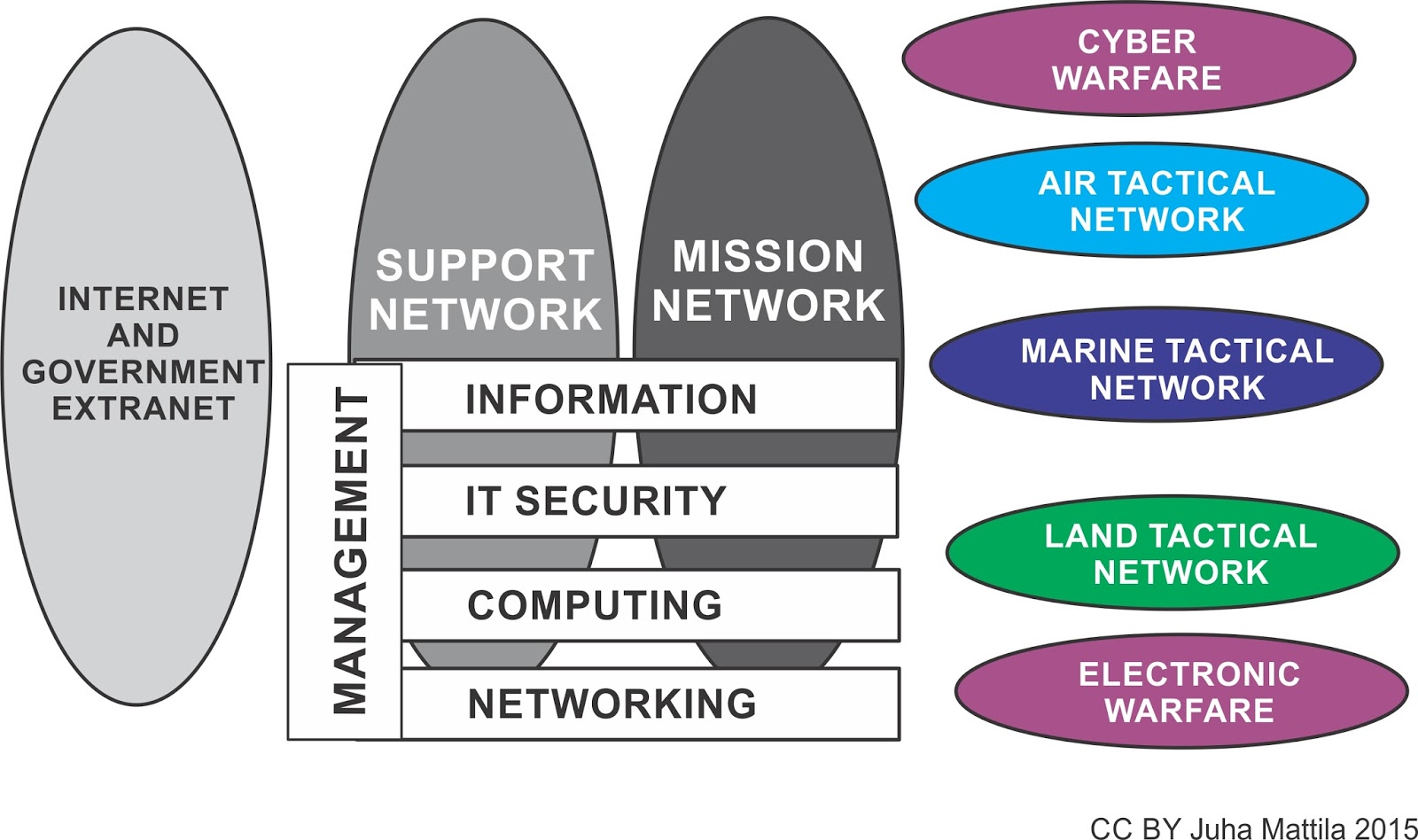
This paper is a part of series of papers that are describing the roadmaps of each layer of CIT technology applicable in military support and mission networks as pictured in Figure 1.

Figure 1: Orientation of military ICT domains i.e. networks

The paper focuses on military support and mission networks like USA’s APAN , NIPRNET , SIPRNET  or NATO’s AMN  and FMN . This paper is not explaining Internet or evolution in governmental extranet nor any tactical military networks.

The series of studies illustrate a major technical evolutionary path for each layer of technology and describes some shortcuts that military organisations have experiencing both when revolutionizing their information management culture or being driven back with negative forces of their culture. This paper provides tools for enterprise architects to do strategic diagnosis using evolutionary roadmap where the current situation can be assessed, and the possible future state may be defined. 

Orientation to Military ICT roadmaps

There is a possibility to create a description of the general evolution of Information and Communications Technology, ICT in military support and mission information environments. A generic evolution is depicted with four aligned roads of Networking, Computing, IT securing and Information Management in Figure 2.

Figure 2: Roads of military ICT evolution

This paper is describing the sub-roadmap for military information or content management  in more detail. See the other papers of this series for a description of all roads on the ICT roadmap.

Digital Information may be divided roughly into structured and unstructured information based on its organization. Unstructured information does not have a pre-defined data model, or it is not organized in a pre-defined manner.  Unstructured information requires a human being to understand it as it is presented mainly as text, audio or video. Structured information is organized according to the pre-determined data model, or it is annotated using an ontological taxonomy.  It can be understood both by human and machine. The study of structured information in a military environment is covered elsewhere in the series of ICT roadmaps.

Description of evolutionary path for Information Management 

The information management in the military environment has been defined by its mean of storing. First information was printed on paper and bind to books or documents which were stored on shelves of a library or archives. The management of information was using bibliographies to publish information on information and physical items (i.e. books or documents) in controlling distribution. Processes were supported by manual flows of paper.

With automated data processing systems, information was captured in digital format, arranged in files, stored in folders and managed by distributing files through email. The management was using physical access to systems, encryption and restrictions in access to folders. The processes were defined by the functions that were using information systems. 

In the cyber environment, the writing or drawing in information production has been first supplemented and then substituted using audio and video. A human being as a primary information provider is gradually substituted by machines which sense their environment and provide both structured and unstructured information in vast magnitude i.e. big data.  The volume, velocity, and variety of this new data have gone beyond the ability of legacy computers to process small data for humans from it. The methods of managing big data cannot be based on material items anymore.

The following sections are explaining the evolutionary stages in the management of unstructured information in a military environment as per their medium.

Print

Since the printing innovation by Gutenberg, the unit for managing information has been mainly a page, document, and a book. Printed paper is still utilized in many official military documents. Sharing of information is based on distributing letters, memorandums, minutes-of-meetings and paper documents. It is considered to be good to manage top secret information on paper because of its physical constraints and manageability. 

File

When personal computing did gain the footage in military official information management, the paper was converted to file and book to the folder. First, they were stored in data mediums like tape, floppy disks, compact discs, memory sticks, etc. Sharing information is based on delivering these mediums containing files and folders. The military is tackling the issue of non-connected systems by transferring information between systems via manual data mediums (like USB sticks or DVD) . The personal level and manual information management expose to risks of data leaks. In the largest military data leak 2010, almost 400 000 classified logs from Iraq War were published by Wikileaks.  

In the Finnish Defence Forces, the first file sharing content management became utilised through 1980’s when personal computers were introduced as common data processing entities. One of the first command posts was using Nokia manufactured PC’s and floppy disks back in 1985.

Storage

Further, these files and folders were stored in hard disks and accessed via file management structures (for example FAT, NFS) - first in single PC’s and then increasingly networked storages. The distribution of files between storages was first done by File Transfer Protocol, FTP or via Email (mainly SMTP).  

The more current ways of managing and distributing files are cloud based. Besides the legacy storage area networks, the storage may also be organized in converged where all computing components are integrated as one computing package.  The other end for cloud computing storage is to use hyper-converged infrastructure, where a lot of standard attached storages are virtualized using software defined storage. 

The cloud-stored files are accessed via different means. Most common file sharing platforms are for example MS Sharepoint, OneDrive, Dropbox, BitTorrent, Netflix. 

In the Finnish Defence Forces, the first Email service (Vaxmail) within a deployed force was provided 1994. Defence Forces wide Email and file sharing service (Esikuntajarjestelma -95) were implemented in 1995. It also included collaborative consumption pages as a private point of sales.

Web page

Publishing information on pages has been there since newspapers. A digital page was introduced in 1980. The method is composed of hypertext (HTML)  structured page, Uniform Resource Locator (URL)  to provide an address to HTML page, Hypertext Transfer Protocol  to provide session between page and viewer, and a web browser  to present the content of the digital page to a viewer.

The military is challenged with this publish and pull method of content management since the culture of “need to know” requires predefined detailed access rights. The MS SharePoint has come one of the most used platforms for both files and web pages (U.S, NATO). There are also other platforms in use as IBM WebSphere (FIN, GER) or Open Source based (FRA, U.S). Most of the operational planning is done via portals and orders are both prepared and shared as HTML-pages.

In the Finnish Defence Forces, the first Domino portal was published 1995 and WebSphere Portal 2007. 

Social Media

Sharing information with social media means has exploded in private life where Wikipedia, Facebook, and Twitter gained popularity. The military has been following this trend in an Internet environment. In 2007, the first military accounts started appearing in social media. In 2009, US started first plans for exploiting the social media. 

The whole change from the one-way publish-pull policy of early Web toward more interacting and collaborating web is called Web 2.0.  Web 2.0 is defined by social networking, video sharing, web applications and collaborative consumption. Military are using enterprise social media tools as part of their content management platforms e.g. SharePoint and WebSphere.

In the Finnish Defence Forces, the first force wide collaboration toolset was published 2010 which included voice, chat, whiteboard and meeting management. 


Semantic Web Information

The next generation of markup Web is called semantic or sometimes Web 3.0.  This means that information is not referred as a page, but the basic unit is a sentence or word that defines the subject, predicate, and object. This language makes all unstructured data readable by both humans and machines. The semantic web uses Resource Description Framework (RDF)  to describe information, taxonomies, and interchangeability features. The Web Ontology Language (OWL) describes ontologies and data syntax is described in Extensible Markup Language (XML). Queries are done via SPARQL. 

Most of the military Open Source Intelligence systems have been using semantic structures in categorising events extracted from data flows on Internet since 2005. Some of the information integration and big data applications in military Enterprise Resource Management have been using semantic models to exchange data. 

In the Finnish Defence Forces, the first Battle Management System based on semantic knowledge model was introduced 2010 and 2015 it was rolled out for the training of conscript troops.  


Intelligent Web Information

The future generation of managing “unstructured” information may be based on research done under the title of Web Intelligence or Web wisdom. It concerns mainly of using artificial intelligence as meta-component of all information. Each piece of information thus possesses some program to enable different ways of processing data. 

One critical for information is to recognize the context where it is required to use. The context or situation can be defined by acquiring more information about the current and compare the situation with patterns of causality history to set the best approximation for intended purpose in using information. 


The map of roads

With the previous seven stages of means in managing unstructured information, one may create a map for possible evolutionary roads that military organizations have journeyed in their attempt to develop information and content management. This roadmap is not based on maturity models and linear improvement.  It is defined by a derivation of evolution model  and tested with samples from military organizations. The roadmap for military information management evolution is illustrated in Figure 3. The main path is following the generic evolution: print – file – storage – page – some – semantic – intelligent. There are also alternative paths for accelerated evolution and reverse or downgrade. The following section provides examples of each journey.


Figure 3: Roadmap for military Information Management


Leaps, shortcuts and paths of downgrading on information management map of possible roads

Military organizations have followed the main path of information evolution. The Finnish Defence Forces have journeyed through all stages but the last as explained in the previous section. Within the Services of U.S. Armed Forces, there are all the stages of information management present at same time.

There are two leaps in evolutionary path that may present challenges for information management culture. The first is a long cultural leap from individually possessed files in personal folders to publish knowledge in pages. From an individual viewpoint, one is first in control of his information by pushing it to others with means like email or access to shared folder. Then suddenly one is required to publish “his” information to everyone by a web page with no apparent control of who has access, reads the content and - worst of all - utilizes the information.  From organization viewpoint, there is first hierarchical control on all sharing of official information. Then suddenly, the commander of armed forces comments publicly a blog writing that private soldier published on lessons learnt in the UNIFIL operation. 

Secondly, there is an extended information structure leap from the huge amount of shared unstructured data (text, pictures, videos, personal sensor data) via enterprise social and other medias towards structuring everything in two additional dimensions: metadata and logic.  The leap is imperative to enable artificial intelligence, machine learning, and improve man-machine collaboration. It has taken two years to the Internet to have 4 million domains using schema.org  markup.  The U.S DoD has been attempting to build horizontal integration of their enterprise data since 2008 by using standard ontologies. 

There is a possibility to accelerate evolution by utilizing shortcuts and passing by some stages. The Land Command of Finnish Defence Forces jumped from file defined directly to the semantic defined battle management system. It required a coherent effort to change technology, ontology of information, processes, and behaviour of people at same time. 

There is also change to downgrade the culture of information management since new technology is providing ways to get rid of old bottlenecks and friction. Search engines, active directory , and access to cloud-based file management  have extended the file based content management within military enterprises hugely.

The 2010 leak of Iraq War Logs downgraded the U.S. and NATO attempts to share information more freely amongst warfighters.  The access to sensitive information was constrained for a single defence analyst. 
 

Examples of the usage of roadmap

The Enterprise architect may use a simple illustration in communicating the current situation of technology, information, business and culture of the military organization. With the same map, the architect may communicate the possible future states and probable challenges on the journey towards end state as illustrated in Figure 4.

It might occur that even if technology enables huge improvements, the information management methods or organizational culture make them unrealistic.

Figure 4: Simple concept for enterprise architecture

With the information management roadmap, an enterprise architect may be able to show tangible the current situation of content management status. If the adapted strategy for information superiority is after utilizing the edge of technology, then semantic web and intelligent content may be the end state. This might be challenging to achieve, since the information management culture of an average society is somewhere around social media and that culture may prevent the full use of technology. 

The more evolutionary strategy might adapt smaller steps and set goals to transform from files to web pages and allow the culture of the organization to develop more iteratively as illustrated in Figure 5.

Figure 5: an example of information management architecture analysis

The cultural stages of military organization in information management are explained in other papers of military knowledge management.

It might be that the technology or culture are not the biggest obstacles, but existing information security policy is preventing the development. Thus, there is a need to express the information management roadmap on the same map as the evolution of information security. For example in Figure 6, the domain based information security is preventing to achieve information management alike social media since there needs to be service based information security in place.


Figure 6: an example of interdependence between the layers of ICT infrastructure

See the previous papers for other ICT technical layers and their evolution in military use!