2016-04-09

Using Evolutionary Theory in Explaining System of systems Development


Introduction

The paper describes one way to model evolution and development of System of systems. In the context of this paper, the System of systems is a socio-technical structure where Information and Communication Technology is intertwined with human and other structural components. Because of openness and intertwined components, System of systems is complex in nature. Thus, there is a need to understand better the relationships and interactions between components and their environment.

The hypothesis for a model is based on Darwinian (1859) Theory of evolution. It is expanded by Mokyr’s (1998) application of the evolution of technical systems. The Mokyr’s system is modularized using Andriani’s and Carigani’s (2012) approach to modular design and innovation. The modular system is then generalized as System of systems.

Mokyr defines knowledge as underlying structure needed to design systems. The model for knowledge is extended using features of Choo’s (1998) model for Knowing Organization. The extended model is projected to the environment of generic human community and military affairs to expose dependencies between entities and their environment. The forces exposed are explained by combining Mokyr’s and Choo’s theories and reviewing them with Bertalanffy’s (1968) general system theory.

Finally, the model is simplified to illustrate essential interactions and dependencies. The simplified model is easier to use in studies of Information and Communications Technology development. For this purpose, the extended and streamlined model is also explained using classical military development example of mechanized forces and maneuver tactics (Vego, 2007).


Darwinian evolutionary model as basis

The standard Darwinian model includes an Underlying Structure (genotype) that defines the Manifested Entity (phenotype). This connection between Structure and Entity is tight so at moment t Structure produces (maps) similar Entities. However, Darwinian model is a dynamic system. Within time, the Structure might change (mutation) and produce different Entities. When Entity (t) and Entity (t+1) are facing the similar stress of Environment, Natural selection may occur. One of the Entities may adapt better to the stress Environment is causing. The reproduction of better adapted Entity may be more vigorous and gradually overtake the less adapted Entity. See illustration in Figure 1.


Figure 1: a standard Darwinian model for Evolution

Natural selection shapes the character defined in Structure and expressed in Entity. Adaptation means that characters of an Entity evolve gradually to fit better into required function. Exaptation means that a character adapted to a particular function is adopted to a new use (Gloud; Vrba 1982). 


Extending the definition of Knowledge and System

Joel Mokyr (1998) uses the Darwinian model in explaining the evolution of technical systems in Human Societies. He names Knowledge as the Underlying Structure that defines the characters of technical System (Manifested Entity) pictured in Figure 2.


Figure 2: Mokyr’s model for evolution of technology

Mokyr proposes that designing or building a technical system needs useful knowledge. The useful knowledge at the moment (t) defines the characters of System (t). The system is used by a community of people for a function in a particular environment. New knowledge can be created by research or experimenting with existing systems. If the newly accumulated knowledge appears to be useful, then new system (t+1) is designed   and build. Natural selection occurs when the community is comparing new and old system and adopting either of them for further use.

An alternative evolution path is opened if users start to use old system for some new functions. While learning by doing, the user might not understand the principles of this new combination, but it seems to produce results. 

The Mokyr’s evolution model for technical systems has been further extended by Andriani and Carigani (2012) in their study for modular exaptation. It states that Systems are most usually evolving at substructure, module level. In combining System from different modules, it becomes possible to adopt modules elsewhere and use them as part of the new combination. The approach opens the third path for evolution model: new modules are designed, composed of previous modules, and existing modules elsewhere are included into the composition. The composition is further called System of systems (Wikipedia 2016) as it is defined by interrelated modules or sub-systems that produce or enable more functionality and performance together than separately. Figure 3 presents an extended evolutionary model for System of systems development.


Figure 3: Evolution model for System of systems

Cattani (2005) extends the evolutionary model further by proving that organizations can accelerate their knowledge creation by preadaptation. An organization can produce modules to fit better in existing the System of system and further usage within the community when they are running parallel design lines and experimenting with various combinations. Preadaptation provides a wider variety of possibilities to choose for production. Accumulated creative capital may appear to be useful further when new functional demands rise (Harford, 2011: 234).


Features of knowledge and information

In Mokyr’s evolutionary model, knowledge is accumulated by research and experimentation. There is also the possibility to learn by doing, but it transfers to knowledge only if the phenomena can be explained with some existing model, thus understood. When knowledge accumulation is studied from Choo’s (1998) knowing organization approach, knowledge creation provides a model to enrich tacit knowledge to explicit with Nonaka’s (2015) SECI process. Innovation is also often based on coopting modules or subsystems elsewhere and utilizing them in a different combination (Christensen, 2011). 

Knowledge can be active when it is referred, and it remains accessible. Knowledge can also be dormant, kept in storage, and not utilized in designing new components. Knowledge has characteristics as follows (Dalkir 2011:2):

  • Using knowledge does not consume it.
  • Transferring knowledge does not diminish it.
  • Knowledge is plentiful, but there are only a few opportunities to use it.
  • Much of the explicit knowledge is lost in filing and much of the tacit knowledge out the door at the end of the day.

So there is a window of opportunity for each piece of knowledge if it is available at the time. As the human community is now doubling its amount of information every two years, there is always information which never reaches the level of knowledge. Besides learning, research, and knowledge creation, an organization can also acquire knowledge with new hires.

Mapping knowledge to design and building new or legacy systems depends on the following status (Mokyr 1998):

  • As long some selecting agents do not share the consensus of knowledge, there remain old design and systems as niches. The military has a tendency to sustain traditions as horses in their ranks long after they were fully replaced by motor vehicles in operations (Guderian, 2001).
  • If some part of knowledge is rejected by the majority of selecting agents, it does not vanish but survives in records. There is a change that after generation change among selectors, previously rejected knowledge find a new use. Frequent rotation of officers in several positions sometimes provide opportunities both to senior and junior officers to proceed with their earlier ideas (Harford, 2011:50).
  • Most of the information are dormant. There is no know utilization for that information until new ways of analyzing information emerges. Business Intelligence and Big Data are trends in trying to make use of exponentially increasing the volume of data (Schmidt & Cohen, 2013:34).
  • Human way to process information. There is a loss of information in human communications. All ways of communication need to be enforced to transfer knowledge. Human recognizes patterns and matches them with most recent or familiar ones to create understanding. Human thinking is tuned towards satisfying rather than optimizing (Snowden, 2012).

Mokyr modeled the awareness of existing knowledge, the unknown knowns, with access cost. The access cost is replaced with Choo’s (1998:61) model for information use as illustrated in Figure 4. For more complex approach one should see Dalkir’s (2011) Knowledge Management in Theory and Practice.


Figure 4: Mokyr’s Evolution Model extended with Choo’s model for Information Use

Choo’s (1998) process for information use includes three functions: Information Needs initiate Information Seeking, which enables Information Use. There is feedback from Use to Needs as process unveils possibilities and constraints. The process runs embedded in two sub-environments: 

  • Information processing environment, where the need and seek processes are affected by cognitive needs and affective responses.
  • Information uses environment, which is defined by the situation of use.

The cognitive needs in processing environment are affected by situational stops, where human faces different gaps, barriers or options when reaching after information. The human uses available bridging strategies to overcome these gaps. Human also has different habits in using acquired information. The affective responses include feelings that are defining behavior. Uncertainty, confusion, and anxiety are examples of prohibiting feelings. Feelings of confidence, optimism and clarity are driving information seeking. Relief, satisfaction or disappointment are the possible outcome from information usage.

Work and social settings define information usage environment. Varying the combination of people facing the same problem produces different outcomes as social structure affects their thinking. Organization, task domain and access to information also define the outcome. Also, expectations concerning resolution and the way it is communicated, have an impact on the solution.


Effects of Community and Environment of use

The model assumes that System of systems is open. It has external interactions with its environment and in this case particularly with its users, the community of human beings (Bertalanffy, 1969:141). Mokyr (2004) defines features of resistance in adopting new systems. Meanwhile, Harford (2011) defines features that might accelerate adaptation. 
In process of natural selection between legacy system and new system, Mokyr defines the following sources for resistance to adaptation:

  • Value. The change will have effect in existing value chain and power structure. There will be stakeholders within the community that feel losing either value or power if the new system is being adapted. Thus, they will oppose the change.
  • Ideology. Human community includes a degree of phobia and conformism that will resist all new. They may be defined at political, religious, cultural or ethnic levels.
  • Epistemology. The existing system and knowledge hold a status of general acceptance. Human nature has a tendency to value possessions over future options. Thus, new information or components may be opposed as they do not fit into accepted understanding or usage.
  • Systemic. Individual autonomic systems differentiate from others only per their features or price. In the other hand, if the new component has a decisive dependency on other parts of System of system, then systemic resistance needs to be considered. When the system of systems grows beyond control, as telex, land line telephone or TCP/IPv4 has, it slows down the evolution.
  • Dependency on frequency. The rate of change and adoption depends on a number of users. In one hand, smaller and better-connected communities adapt new feature quicker than larger. The other hand, the large, well-connected population may adopt new features faster as social imitation/learning surface extends and touches more people. Some changes do follow a particular path of evolution that makes them more resistance to further changes. For example, a service established by legislation may enjoy protection from competition and natural selection.
  • Comfort. Human being is seeking status quo with routines and rituals that provide comfort for everyday life. This comfort is further stabilized with habits that lessen the stress of decision making. In stressful situations, human often has a tendency to use familiar or previously proven solutions than unprecedented. Similar deepening comfort zone i.e. funnel of comfort is with communities as they seek stability (Duhigg, 2012).

There are also features in organizations ability to design new system that produces natural friction:

  • Lack of complementarities. New knowledge may be available and useful to design a new module, but manufacturing technology is not mature to support building the physical form. The asymmetric situation is familiar to communities, whose strategy is defined by staying on the very edge of technical evolution.
  • Speciation. Language is used in communicating existing and new knowledge. Some areas of expertise may develop jargon to differentiate themselves from the rest. This linguistic speciation may prevent dissemination of knowledge. Differentiation may also be founded at political, ethnic or ideological level. New understanding does not easily overcome barriers rooted in beliefs or upbringing. The base of trust is also powerful differentiator especially in the area of information security. It is hard to move the base of trust from physical formats towards virtual formats (Mattila, 2016).
  • Organization structure. The organization, that is ought to produce new systems or their components, effects the outcome. Deeply functional and specialized organization can produce mainly components sized according to their functional unit. Cross-unit development does not occur unless there is a willing authority above all units involved. Matrix or composite organizations are more flexible and oppose less when creating new concepts and designs when a network of value changes (Christensen, 2011:33). Connectivity of the value network is also defining the adaptation of new modules. The more connected organization is, the more open it is to new knowledge and exaptation of useful modules.
  • Entropy. The second law of thermodynamics can explain the loss of information as well as the gradual disorder that grows in open evolutionary systems. Information loses its content and integrity when communicated due uncertainty or entropy in a channel. The open socio-technical system also has some dynamic microstates with their agendas, both human and technical. The human community always has subcultures and unofficial organizations that affect the official organization and dominant culture. (Bertalanffy, 1969:143)

Figure 4 illustrates the effects of community and environment to embedded System of systems.


Figure 4: Environment and community effects in evolution of open System of systems

There are also positive forces in environment and community that may accelerate the evolution:

  • Curiosity is a mean that fulfills the human need for knowledge or truth (Reiss, 200:31).
  • Strategic transformation or changing environment is best approached with adaptation. Based on Donald Sull (Syrett, 2012:100) this is achieved by building three capabilities: 


  1. A strategic anticipation to recognize patterns of change
  2. Organizational agility to exploit opportunities or mitigate threats as they unfold
  3. Resiliency to absorb uncertainty and surprises


  • Adversary or Competitor may change the status quo of confrontation by action because of intolerable pressure or try to exploit occurred opportunity. Both states and enterprises are mutually dependent in a way that action prompts a reaction from other stakeholders (Porter, 1980:16). 
  • Challenges of everyday life drive the process of evolution. When facing a problem, one tries out few variants available to solve it. Failures are weeded out and successes copied. This process of variation and selection goes on and provides constant drive (Harford, 2011:12). The sociotechnical system evolves with this process at the micro level (Tavistock, 1989). 
  • Maturity. The S-curve theory of technical improvement explains that in the early versions of new systems, the pace of technical improvement is slow. With better understanding, control and diffusion, the rate of technological improvement will accelerate. In later stages of maturity, improvements will asymptotically reach a natural limit, hence the S profile (Christensen, 2011:44).


Optimistic model for evolution of System of systems

A system that composes of individual subsystems that are interrelated is called System of systems (SoS).  The SoS is open and interacting with its environment and community that is using it. The SoS has been designed to fulfill a function based on knowledge that the community possess and can use. As an open system, the SoS has a tendency to lose its coherence gradually with time. Friction and entropy are powers that change the structure and usage of SoS at the micro level. 

There are three main paths for System of systems to evolve:

  1. Preadaptation is driven by the need to develop new SoS’. It includes research, experimenting or acquiring new knowledge with other means. Several optional solutions may be produced and explored to find the best fit. Gained knowledge and prototypes are used to design new SoS’ to fulfill the requirements of the new function.
  2. Adaptation happens when the SoS is coopted gradually for different usage without necessarily understanding why it fit to the new function.
  3. Exaptation occurs when component C from another system is coopted as part of SoS’ in making it more efficient or fitting to the purpose.

There are driving and resisting forces that effect in the evolution of function and SoS. This optimistic model is simplifying them into two opposing forces: Resistance and Drive. The optimism is the decline in the picture in Figure 5. The model assumes that there is a generic drive to improve and develop the performance of community, systems it is using, and knowledge it possesses.


Figure 5: An optimistic model to explain evolution of System of systems

Knowledge is imperative in preadaptation and exaptation. For knowledge creation there is a process of information need, seek, and usage. Environment and community are affecting this process from cognitive, affective and situational dimensions.

The model can be explained with different evolutions of socio-technical systems, but one of the military classics is the development of mechanized warfare before the II WW. Heinz Guderian has been recognized as one of the main inventors of mechanized warfare. He wrote 1936 a book called Achtung – Panzer that described battle tank as component enabling mobile warfare when supported with radio communications, motorcycle reconnaissance, and close air support. He proved the case by leading the attack of his armored forces through the Allied defense 1940 with speed that overtook the Allied leadership by surprise both at tactical and strategical level. Speed and firepower of maneuver tactics were named “Blitzkrieg”. Later 1951 in his book “Panzer Leader”, he described the challenges faced when trying to develop new mobile tactics within the Wehrmacht through 1930’s. The first battle tank was coopted (Exaptation) from earthmover as tracked vehicle that was able to carry armor, large gun or having high maneuverability.  Singular tanks were used during I WW with variable success. After the war, their technical development went further, but tactical use remained at the level of singular weapon platform (Adaptation). 

Guderian explained these facts, proceedings in technology, and defined new tactics for land warfare in 1936 (Preadaptation). The generals of cavalry did not favor his ideas (Resistance). Despite this, he continued developing (cognitive means and affective responses) panzer tactics in motorized logistics company using trucks and cars (Experimenting or Domain-driven Design). He also cooperated with Luftwaffe as they were developing dive bomber (Ju 87) 1935 and introduced close air support (Exaptation). Artillery pulled by horses were not quick enough to support mechanized spearheads.  The strategic need (Drive), for Germany to increase tactical speed, overdrive the resistance. When Germany launched the offensive 1940 against France and Allied defense, there were as many battle tanks on both sides. The Guderian way of using armored divisions and operation plan created by Manstein (Melvin, 2010) made the crucial difference and results prompted others (Soviet Union, USA) to copy (Adaptation) mobile tactics with variable outcomes.


Discussion

The main objective of this paper is to present a logical model to study the life cycle of open socio-technical systems and causation of their development. The model seeks to improve the understanding of evolution in the usage of Military Information and Communications Technology.

The model is based on Mokyr’s evolutionary model for technical development. It is further extended by Andriani and Carigani’s (2012) modular exaptation to create a better understanding of System of systems development. Intentional knowledge creation is explained using Cattani (2002) model of preadaptation. Choo’s (1998) approach for the Knowing Organization is used to understand better forces affecting information processes. Christensen (2011) introduces exaptation as a possible path for evolution. The composed model is evaluated against Bertalanffy’s general system theory as major forces effecting evolution are simplified. Finally, a practical, optimistic approach (exploitation phase in the flow of events in Gunderson & Holling’s (2002) Panarchy model) is chosen in providing the model with a positive incline towards development.

The model is defined only to sufficient level to gain a robust understanding of forces and interrelationships in the evolution of socio-technical complex systems. The model is used in other papers to study the evolution of military Command, Control, Communications, Computers and Information System of systems and related functions.

At the macro level, the model does not consider for example transformation model developed by Gunderson and Holling (2002). At the micro level, presented model does not describe a holistic open system with feedback and decision-making functions special for social behavior (Ackoff & Emery, 2008). It requires further Systems Thinking, Modeling and experimenting to be matured and detailed. The model creates a generic framework to study recent Information and Communications Technology related developments, especially in Military Communities.

2016-03-19

A Way forward in developing the key capabilities of Nation Defence in Finland by using Enterprise Architecture views

A WAY FORWARD


The strategy for the FINDEF was first to create an enabling ICT structure that would provide leverage to process rethinking and integration. The third phase was to build new capabilities required in National Defence. The sequential strategy was based on the understanding that strongly siloed ICT structure was preventing information and processes from integration. Further, there was understanding that without platforms to develop integrated processes and shared information environments, there were no gains achieved in developing asymmetric military effects illustrated in Figure 36. 

By 2008, the first phase was achieved, and the description of enabling ICT structure as part of the defence system in Finland was described as a nationally defined service platform for common and joint processes. The technical structure included core network that connected data centres providing application and content services accessed via access networks. Tactical level field networks were connected to nation level structure via connection points.


Figure 36: Simplified model for improvement strategy for the Finnish Defence Forces 2004

This writing was focusing on the first phase - transforming the ICT structure so that it would enable further proceedings in developing common and joint functions of military affairs. The transformation of ICT structure in Finnish Defence Forces 2004 – 2008 was following basic lines of evolution in using ICT to support military strategic and operational functions as pictured in the following Figure 37. The evolutionary model for ICT application includes interrelated layers of Networking, Computing, Information Security and Information Management. 

On 2004, the Finnish Defence Forces were using transport networks based on Synchronous Digital Hierarchy in connecting garrisons and command posts together. Computing and communications services were provided mainly within local areas and branches in each garrison. Each garrison created a local domain that was loosely connected to other garrisons enabling data sharing. Information security was based on ownership of physical and technical domains. It was trusted since it was operated and developed under each line command: North, East, West, Air and Navy. Connecting the trusted domains to other domains was untrusted. Unstructured official and unofficial digital information were produced in files created in various formats and stored in Folders managed mainly by individuals. For sharing of information, there were some shared Folders and disks accessible to carefully defined users. Most of the files were shared by intranet electronic mailing system between individuals.


Figure 37: The journey of the FINDEF 2004 – 2008 on the roads of evolution of Military ICT usage

The transformation accelerated the ICT structure to the level where networks were specified supporting more centralised computing and multichannel access. Computing was based on virtual infrastructure providing both distribution for survivability and flexibility for new requirements. Information security was based on a trust in systems as they were more controlled, end users were separated from services, and there was a structure for defence in depth built. The file oriented information management culture was gradually moving via page sharing to more real-time sharing culture of enterprise social media.

The transformed ICT structure enabled the major change of the Command structure of the Finnish Defence Forces. There remained only three commands: Land, Maritime and Air. The National University of Defence provided a level of academic knowledge and education needed in Force Production and specialised units directly under the Defence Staff were providing unified support to all Commands.  

Defence Forces had taken its first step towards process supported matrix and virtual enterprise. The step was enabled by new ICT structure dividing Military Affairs into four domains of shared information: Tactical, Operational, Support and Public. The domains are described in Figure 38.


Figure 38: Information domains of the Finnish Defence Forces 2008

Tactical domain remained further divided into Intelligence, Sensor, Fires and Land Forces deployable field networks. OPNET provided a platform for nationwide military missions at operational and tactical levels. Tactical domains were connected to OPNET providing interoperability and coordination required in joint and combined operations between Services, Allies and other Governmental Agencies. HALNET and INET were connected in a way that enabled establishing the Force Production and Support in the more cost-effective manner by using example strategic partners for Logistics and Training.

The four domains provided Information Environment to further process development in all three military areas: Force Utilization, Production and Support. The ICT infrastructure enables information flow within the Defence Force but also between its key partners. A basis for more efficient National Defence value chain illustrated in Figure 39 was created. Further papers will explain proceedings at the process level and the development of Land Forces Tactical domain on their journey towards a new strategic basis for National Defence.


Figure 39: The 2008 platform created with ICT structure for developing essential capabilities in Military Affairs of Finland


This is the final paper in the series of eight (A - H) studies describing how the ICT structure of the Finnish Defence Forces was transformed before 2008.

2016-03-13

Architecture for Information Management Transformation; Part G of Introduction to ICT rationalization program of the Finnish Defence Forces from Enterprise Architecture viewpoints

TRANSFORMING THE ARCHITECTURE OF INFORMATION MANAGEMENT


STARTING FROM BASICS


The digitization of unstructured formal information had started already in early 1980’s in the Finnish Defence Forces. First there were Personal Computers introduced to replace typing machines. Then, at mid-1990, the first digital content management system was implemented to capture both personal emails and formal correspondence together with the publication of standard operational procedures. The system was based on Lotus Notes in the beginning and included taxonomies and metadata models for all formal unstructured information exchange and records keeping within the FINDEF. There was a demand in early 2000 to update the content management system and migrate from Lotus file types towards Microsoft files. The main driver was to achieve interchangeability between other stakeholders. 

The same time, there was a need to update the whole content management system. Thus, a roadmap for migration of file types was created starting from early SmartSuite version 4 evolving through Office XP towards more open file types based on eXtensible Markup Language, XML. The roadmap is illustrated in Figure 31.


Figure 31: A roadmap for migrating the file types for unstructured content within the Finnish Defence Forces

There was a migration window for all legacy file types from SmartSuite version 4 to most current version 9.8 defined. The migration window pushed all content towards one format, SmartSuite 9.8, which was to be supported in read-only function until 2008. All earlier versions together with their applications were cancelled by 2005 (version 4) and 2006 (version 97). The simplifying of office suites also helped in cutting the local support and providing a more stable configuration in workstations. The Microsoft Office 2003 version was defined to be the first family of file types providing a path towards next MS Office versions and more open file types that enabled publication of content as well as archiving better that proprietary file formats.

New file formats opened integration opportunities in IBM Domino, SAP and IBM WebSphere platforms as they were introduced as part of process integration programs in Enterprise Resource Management and C4ISTAR implementation. Integration improved the transferability between unstructured and structured data.

RECOGNISING SITUATION OF THE MATURITY IN CONTENT MANAGEMENT


When the maturity of content management was assessed in the FINDEF, there were three main levels found pictured in Figure 32.  The lowest level was based on individual interests, separate ways of working and personal applications in personal computers that stored personal files. Individualism was recognized the hardest cultural boundary to break as some of the Branches and Units within the FINDEF were using Confidentiality as an excuse not to share any information.


Figure 32: Measuring the maturity of content management in FINDEF

The second level of maturity was found in teams and units that were competing against each other, sharing within the team but not elsewhere and sometimes having surprisingly advanced applications to manage their files. There were many closed workplaces established in Lotus Notes platform; each  Unit had their intra-web page for internal publications, and closed networks hosted shared drives for restricted content.

The third level of maturity found was Defence Forces wide. Official letters, records and standard operational procedures were captured in common parts of Lotus Notes.  People were thinking disseminating information beyond their particular department or team. There were some attempts to share instruction and training content between Defence Schools and Units of Force Production. There were repositories for forms and templates to assist in writing more structured letters and orders. Official letters were accessible to all authorised personnel back to three years in time.

Since the variance in content management culture was found wide, a significant threat was detected for process integration. Thus, ICT rationalization program was tasked to enable the acceleration of content management maturity. The acceleration intention included following goals:
• Enable social communication
• Enable more formal publications
• Enable content sharing with stakeholders outside of Defence Forces 
• Improve the confidentiality of content through all sharing and exchange transactions
• Enable content transformation between unstructured and structured repositories 
• Build ability to improve formal and structured data exchange between all relevant stakeholders.


ENABLING PROCESS INTEGRATION AND MATURING THE CONTENT MANAGEMENT


TIERA implemented tools and services to improve communication between people and machines as well as the maturity of content management as defined in Figure 33.


Figure 33: Enabling communication and content sharing in the FINDEF

Social communication between people was enabled with Collaboration tools like IBM SameTime. It enabled people to have virtual meetings by sharing presentations, white board and exchanging opinions both in voice and chatting. The collaboration was later enabled also with Video Tele-Conferencing, VTC service between all Units. VTC also enabled unintended signals, body language, included in virtual meetings. These enablers were used 2010 when remote work was officially allowed in Defence Forces. People were permitted to work from the nearest garrison rather than commuting through half the Finland every day.
As telephone devices were taken away from desks, the Computer Telephony Integration in SameTime enabled better awareness of presence and conference meetings. Intranet chatting was also adopted quickly by personnel for informal communication while working. 
Shared folders and web pages were substituted with two portals both for Administrative and Operative Environments. People were recommended to publish content on those platforms rather than in their restricted web pages. Pages begun to capture more content from shared files as HTML editing and publishing become easier.

Content sharing with outside stakeholders was improved by creating digital workspaces to be used in integrated projects and development tasks. The official Internet email MIL.FI was secured better, accessed directly from Intranet workstations and file transfer was allowed in controlled manner to get rid of private file sharing with memory sticks.

Similar file sharing was enabled online between Administrative and Operative Environments to have control over the content that flows between confidential levels. Filters and content screening was applied in gateways for monitoring purposes. Enabled official file sharing gradually throttled the informal file sharing and security improved.

As SAP was extended to be the Enterprise Resource Management platform and WebSphere become the portal platform, there was a path created by improving exchange between unstructured and structured data. The Excel-application from MS Office suite was integrated with SAP platform and allowed transfer of data between two worlds. It was imperative that commanding officers were able to extract data from SAP and create reports and presentations quickly and based on factual information. The Word application was similarly integrated with Domino platform and enabled the transformation of Word-document to Domino content.
 

XML-interfaces (XI) were prepared between SAP and the stakeholders along the value chain via electronic message broker. A gateway structure was providing secure and unbroken transactions between nodes in a long chain of value creation. Another gateway was created to allow outsiders access the SAP of FINDEF. The gateway allowed strategic partners to manage essential information on material warehousing and repair. Information integrity was important for the Defence Forces ability to sustain readiness and be able to deploy forces as needed. The third gateway enabled operations abroad to access home services. It was not necessary to establish isolated entities for support systems in operations anymore. The crew in operations focused only on providing battle management system services to troops rather than running administrative support systems. They were provided via global connections from Homeland. See the concept of information exchange between stakeholders in the value chain in Figure 34.


Figure 34: New gateway structure for data exchange between relevant stakeholders in Defence

TRANSFORMING THE CULTURE IN INFORMATION ASSURANCE AND MANAGEMENT


In enabling the cultural transformation of content management in FINDEF, there were three parallel lines of operation adopted: Information Management, Information Assurance and Computing. The transformation to these enablers is illustrated in Figure 35.


Figure 35: Basic plan in transforming information management, assurance and computing in the FINDEF

The line of information management included support to get rid of last paper-based content and migrate towards electronic documents. It was enabled by content integration, collaboration and new publishing services. The second course of action was to migrate from file based content management towards page and database data management. The migration was enabled by publishing services, tool integration and improved information security. The third course of action was to change the feeling from individually owned content towards Defence owned content. It was imperative to change the culture of “need to know” towards “need to share” to build the Defence Forces as learning organization.

The line of information assurance included increasing the awareness of rights and responsibilities to an information user. The user profile means both consuming and creating information. The awareness was established with the integration of security guidance and operations guidance into the same document of standard operational procedures. The integrated procedures made it was clearer to the user, what was possible and what was not allowed. The second course of action was to improve understanding of publishing and accessing information. There was a profound mistrust of people that prevented publication of sensitive information. It was mitigated by showing what role based access management means and providing exemplary behaviour models of improved ways to publish information. The third course of action was improving the awareness in information confidentiality among users. From individual responsibility, the transformation was done towards organizational responsibility for managing content between levels of confidentiality.

The line of computing included improved access, identity and role management. It enabled an access both for strategic partners and via wireless access. Identity was uncoupled from terminal devices, and Microsoft relied on functions. A full smart card based identity management was introduced together with Single Sign-On, SSO feature in making the life of end users easier but simultaneous the access more secure. Assured identity was transferred to role management instead of applications. Role management provided an underlying layer to manage different roles and their rights to access services and use information. It was possible to differentiate individual and his roles in peace time and war time. Definition of roles become a responsibility to superiors and organizations. Human resources were accountable for issuing smart cards to true identities. A Chief Information Officer was responsible for the whole in each Unit of Defence Forces. 
System administration was linked to service management and extended with role and identity management with rigorous implementation of ITIL-processes and IT-service management system. The integrity of services and availability of information become a driving force for ICT Service Provider organizations together with information security.

This ends the series presenting the Transformation of the FINDEF from Enterprise Architecture viewpoints but the conclusion still to be published!

2016-03-04

Architecture for ICT Service Management; Part F of Introduction to ICT rationalization program of the Finnish Defence Forces from Enterprise Architecture viewpoints

ARCHITECTURE FOR TRANSFORMATION OF ICT SERVICE MANAGEMENT AND PRODUCTION


STRATEGY FOR TRANSFORMATION

The FINDEF had IT Management distributed to all its units, and each provincial command had a provider for communication services before 2004. All ICT was mixed as same units were providing both tactical, operational and strategic services. A strategy was defined to consolidate gradually existing structure and then specialise and network towards future in creating more core value to information enabled Defence Forces.  This transformation is depicted in figure 26.


Figure 26: a plan for transformation of ICT service production in the Defence Forces of Finland 2004 

From all distributed and organic ICT units, the first step was to consolidate them under one umbrella of ICT service provider for all operational and strategic services. Only tactical ICT remained with Services and units. The Services (Air, Navy, Land) also became ICT service providers as tactical services were also delivered in the operational and support domains. The consolidation also prevented hasty and sub-optimized decisions of outsourcing as single units were facing a lack of human resources.

The consolidated in-house ICT service provider, C4I Agency, was then planned to network and co-operate with other providers of ICT services in the public sector and also with major telecommunication service providers in the private sector. The networking was after increased cost-efficiency while using the whole weight of the FINDEF ICT budget. There was also some out-sourcing done while ICT infrastructure was transformed. The telephony was outsourced to two operators: Erillisverkot providing TETRA -trunk radio services  and Telia-Sonera providing GSM-services. Partnering with them also accelerated the maturing process of the C4I Agency. 

As the professionalism of ICT service provider was improving more production responsibility was given to it. The Services were tasked to provide tactical information services in tactical domains, but the C4I Agency was ordered to provide them in operational domain. So Land Command became a sub-provider to the C4I Agency, who provided Army Command and Control Information System as a service to all troops that were operating on land. The sourcing steps gradually matured the capabilities of ICT providers for network operations in the time of war.

The final step in ICT business strategy was to improve the National Co-operation in crises times by providing common operational information to key agencies within the Government. The C4I Agency then provided service to Police, Border Guards, Customs, Civil Defence and all ministries. The new segments of users also provided more volume for ICT services, ensured critical mass and helped to sustain both competence of people and negotiation status with vendors. There was also a plan to partner with other service providers. The Enterprise Resource Management system built on SAP-platform was decided to be a joint venture with prominent SAP service providers  as the FINDEF did not have enough flexibility in their policy of hiring high-level IT-experts. The other dimension for partnering was considered to be in basic network services when the initiative for government network was launched by the Ministry of Finance. 

MATURING ICT SERVICE PROVIDER CULTURE AND PROCESSES


The transforming ICT business architecture called after maturing service operations and culture. There was a vision that ICT would be gradually considered as an enabler for improvement and finally a bringer of new opportunities for the core military affairs instead of considered only as support or worst case just a cost item. The vision in Figure 27 was based on a gradually improving understanding of information and its value for military affairs. As the value of information increases, the focus turns towards information and knowledge management. Technology turns into an asset for Command, Control and Information. The information defence becomes essential as the value and dependence increases. 


Figure 27: The vision and Journey for maturity in ICT Service Production in the FINDEF 2004

The journey towards the end state defined in the vision started from very low-level goals in improving existing system management capabilities. The movement towards process and team based working was launched substituting the way where isolated individuals were doing heroic deeds. With new ICT system management technology some manual functions and processes were also automated. 

The second step included steps towards more mature value chain management in all C4I matters. The relationship between provider and client needed more trusted foundation. The cost awareness and cost projection required to be established in Enterprise Resources Management. There was a degree of force behind this change since new requirements were expected to rise during major change of Defence Forces towards 2008.

The third step would bring C4I Agency to level that it would be up to the level with other Service Providers. Teams inside Agency needed also be more responsible and connected with other to shorten the reaction time and improve efficiency in process based service delivery. There was also need to clarify the differences between ICT Management and Information Management as the role of Chief Information Officer was introduced in each unit.


BUSINESS ARCHITECTURE AND MARKET SEGMENTS FOR ICT SERVICE PRODUCTION


As the Defence ICT transformed and matured towards the vision, there was a need to define market segments and specific business strategy for each segment. The six main segments illustrated in Figure 28 were:

  • Administrative customers within the Finnish Defence Forces included all units within FINDEF in their peacetime role
  • Operational customers within the Finnish Defence Forces included all units within FINDEF in their crisis time role and units of other government security agencies
  • Other Security Agencies via Security Network Operator as TETRA mobile service.
  • Other governmental entities via the IT-centre of the Government mainly with IT related services.
  • International operations either via NATO ICT-service provider or Crises Management Office, CMO (intended avenue for further United Nations Operations)
  • Open ICT-market via commercial service providers (mainly telecommunications related services).


Figure 28: The business and market plan for ICT service provider of FINDEF 2004

All ICT services were delivered with metrics for quality and cost. They were measured by agreements, contracts or objectives defined with clients in each market segment. Service Level Agreement, SLA was typically used within Defence Forces, where costs were transferred but there was no in-house billing in place. Service Level Contract, SLC was used with other service providers when money was transferred against delivered value. 

There were different pricing and billing policy in each segment because of their market status. Within government only direct costs were charged. The value creation of open market was tightly controlled by the law preventing the distortion of private markets with public financing.

Besides the pricing and different quality of service attributes, all services to each segment were produced in the similar process, which simplified the actual ICT service production. Network connections between air defence radar stations for the Air Force were provided the same way as connections between TETRA base stations for the SECNET operator.
There were two main ways to provide the service: centralized and distributed. The centralized meant that there was only one unit providing that service. The distributed meant that several regional units were providing ICT services in their particular area of responsibility. 

The ICT value chain included sub-providers both in-house FINDEF and outside of Defence Forces. They were bundled in as channels and integrated by contracts and processes. Architecture Team was taking care of the interoperability through changes and migrating in new systems. Business Team was taking care of advising in contracting, vendor management and measuring value through the chain.

Development of new ICT features was accomplished through Development Department. It managed several integrators that were assembling material, information and programs together before delivering them to C4I Agency for final integration.


TRANSFORMING THE ROLE, RESPONSIBILITY AND MINDSET OF LOCAL CHIEF INFORMATION OFFICER


With rationalization of ICT structure and service production, the role of local ICT unit changed the most. The local Chief of IT or Technology or Signals that used to manage the whole stack of technology, administrators, operators, end users and their information changed within few years as depicted in Figure 29.


Figure 29: The role and responsibility of local Chief of IT before rationalisation 2004

The workstations and terminals were provided as service and the only thing remaining was to monitor the quality and cost-efficiency of working tools. All servers were consolidated to C4I Agency together with their administrators. All applications were provided as service, so only their usage and cost-efficiency remained under local responsibility. All cabling, networks, exchanges and their operators and technicians were transferred to the C4I Agency and provided as service to units. Even ICT service support was rationalised with ITIL processes and accessed via phone and trouble ticketing systems. Problems with workstations were solved online with remote access. The once so great manager for IT and Technology was suddenly left with no job or responsibility – or so it seems at a quick glance.

The new role of Chief Information Officer, CIO was created. She turned the focus from technology towards information, users, and processes to provide benefits. As C4I Agency provided all ICT assets as service from cable installations to applications, there was but planning, ordering and monitoring left for CIO in managing technology. She was supported by Liaison Officer from C4I Agency, who helped in transforming the items in ICT Service Catalogue to valuable services for her unit and agreeing on all this in Service Level Agreement as illustrated in Figure 30.


Figure 30: The new role of Chief Information Officer after 2006

Then the actual information management was begun. With improved cost-awareness in technology, there was a foundation to start planning and monitoring the cost-efficiency of the information usage within the unit. Focus was also turned to process improvement and skills development as information was creating more value to core functions of military affairs. The CIO was improving the working habits, ergonomics and productivity of those involved in staff and knowledge working. She also started to pay attention to staff processes and their improvement as the heads of 6 in each Service became more aware of this potential.

The change was major from an individual perspective. People were supported with information, training for further understanding, workshops to create participation and with recognition of successes in change. Some of the former technical chiefs were able to change, but many moved to other responsibilities and gave room to new competencies. The figurative change in gender actually happened in some units.

End of part VI

2016-02-13

Architecture for Information Security; Part E of Introduction to ICT rationalization program of the Finnish Defence Forces from Enterprise Architecture viewpoints

This is the 5th part of article on Enterprise Architecture views in Transformation of ICT in the Finnish Defence Forces between 2004 - 2008.

Architecture for Information Security

Starting from proximity restricted trust model


Before 2004, the FINDEF had followed very typical information security architecture  based on trusted physical sites and encrypted communications between them. The trust model was extended containing more logical levels as forces were deployed over to several bases and shared information assets. The approach was outstretching the physical perimeter control as logical domains extended over several physical sites and risks were increasing. Encryption between sites was approached as the only means to build “fortification” in logical dimension. No major attempt was taken to control what was happening within the physically controlled and logically encrypted cyber fortress even though the environment was flat from a security viewpoint.
  
The domain based trust model was divided into the following security levels:

  • Open or public level was considered typically featuring The Internet, poster, publication and postcard.
  • The unrestricted level was filtered from open level but did not possess any additional hardening or encryption. Military Internet access and service domain was a typical example of this level domain. It was connected to The Internet via Firewalls that were to filter the traffic and protect from malevolent logical outsiders.
  • Basic level was capable of handling restricted and confidential content since the connections were encrypted at Layer 2 level between physically controlled sites. The basic level domains remained physically separated from The Internet and unrestricted level domains. Air Gap featured this separation. Those Services or Branches in Military that wanted their information being separated from others at a basic level applied additional Virtual Private Network encryption in their communications.
  • The extended level was physically isolated from all other levels except one way “diodes” that provided one-way transactional gateways to transfer lower level information to higher level domains. The extended level was providing information management domain for secret digital content. Major features in differentiating this domain from lower levels were additional layer three encryption and constrained amount of people having access to the sites that provided workstations for this domain. Of course, some Services and Branches took their systems to be more secret than the rest in extended level and isolated them at least with a firewall if not physically.

The physically featured trusted domain structure killed all flexibility and mobility intentions and ended up building several parallel systems and domains. One operations centre did have five parallel workstations for each operator with separate access to Internet, Admin, Land, Navy, Air and Intelligence services. The concept of information security architecture of the FINDEF 2004 situation is illustrated in Figure 22.


Figure 22: The concept of information security architecture of the Finnish Defence Forces 2004


The As-Is Information Security Architecture led Defence Forces into situations where:

  • Information flow was unofficially “sneaked” between levels and domains by using transferable mediums like CD-ROM’s and USB-sticks.
  • Headquarters typically downgraded their staff work to manual as official information systems were slow in following them to field exercises and operations.
  • Much secret information was travelling in possession of personnel unauthorised and led to occasions that it was stolen along with suitcases, laptops or memory sticks.
  • Audio communications were not following the information security architecture. It resulted in many cases that confidential information was shared via less secure communications by voice since digital sharing was constrained.
  • One staff officer told after an intensive exercise when chief information security officer did a hot wash up of detected security issues: “It seems that when I am trying to support the troops on the ground, I end up always violating some security controls!”

Security was not aligned with military affairs but become an art itself , and that was not raised by many since confidentiality also was supporting their independence. It was although clear that following existing security architecture would keep the FINDEF from reaching mobility, situational awareness, information sharing, survivability, process integration and other network enabled capabilities. The list of constraints was long enough to the commanders of FINDEF to call the change.

Vision of content-based security


As early as 2002 the US Joint Forces Command (US JFCOM) had a Content Based Information Security (CBIS)  demonstrated as part of their Advanced Concept Technology Demonstration programmes. The CBIS was based on entire different trust base than the previous physical site and network partitioning oriented. There was three new bases of trust introduced:

  1. Information being labelled based on content and then encrypted accordingly
  2. Strong identification, authentication and authorization mechanism based on something that user has, knows and is.
  3. Sharing information based on a match between the content label and user’s security attributes.

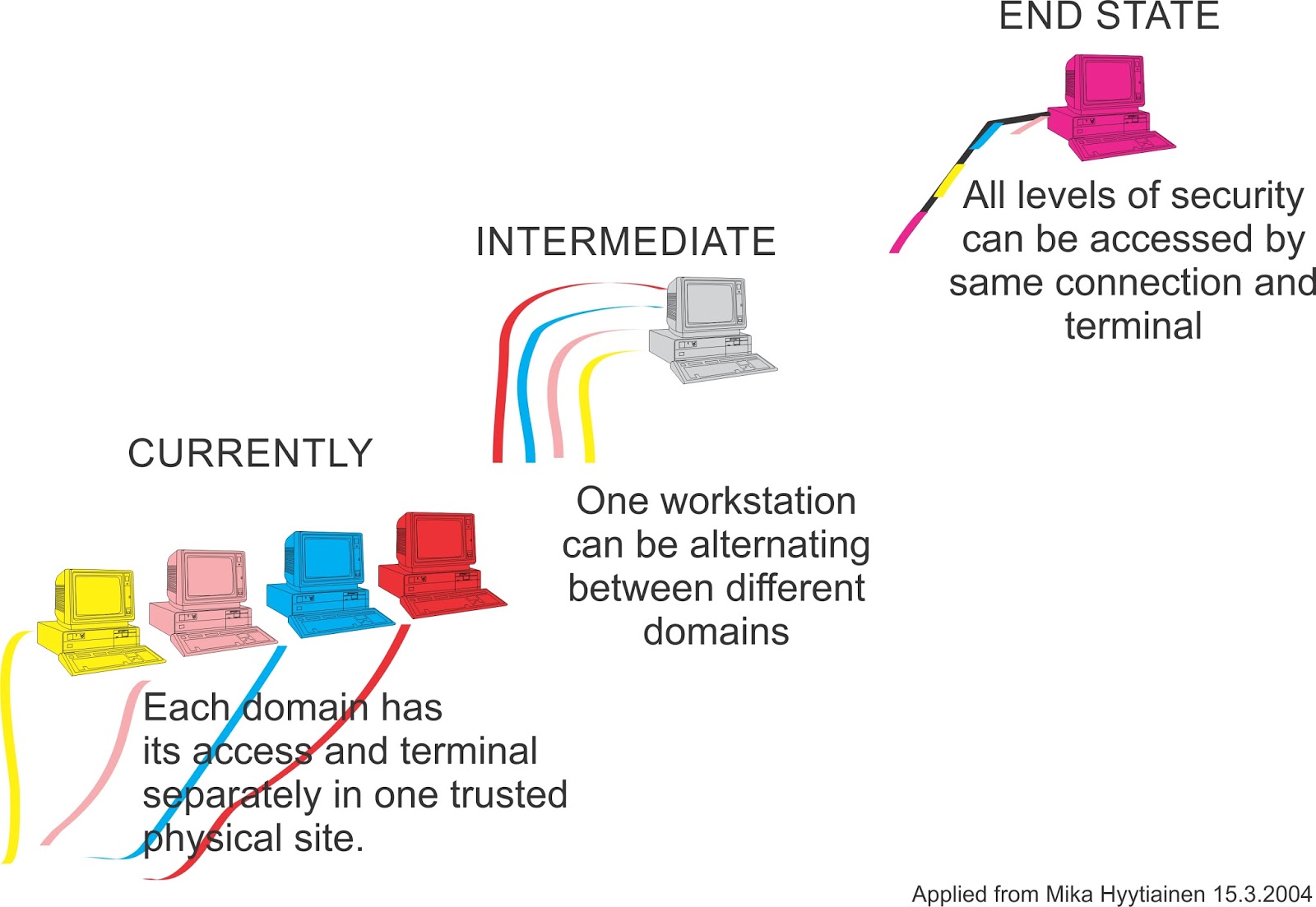
The approach was called information-centric partitioning and trust base was shifted entirely from physical level to logical level. The logical level would be able to provide a road map leading from separate terminals and connections gradually to one terminal with multiple connections and finally to one terminal with one connection as pictured in Figure 23.


Figure 23: Content Based Information Security Roadmap from End User View 

There were the following roles and responsibilities defined in process to suppress the opposition from “need to know” representatives: 

  • Author provides the content to be reviewed
  • Publisher reviews and approves content to be published and defines this with labelling and encryption
  • The reader can access content only defined for his role by the publisher.

There was a strong hope that if US JFCOM can proceed with this approach, they could be the support for FINDEF in the struggle against legacy security policies in NATO.
Unfortunately, the reality overrode the good initiative. U.S. and NATO did not proceed with these ideas until 2009 when it was called after from ISAF operation and then implemented partially in Afghanistan Mission Network. The other threshold on this road was immature content management in FINDEF at a time. The unstructured documents were labelled as files rather than per content. The structured content was labelled only as systems or domains. Analysis of the situation provided a recommendation that content based labelling culture would take too much time to build.

Reality pulls down blue sky intentions


The real solution needed to be found mitigating the maturity of existing content management. It was also constrained by NATO’s legacy trust base. Some system owners, trying to sustain their independence behind “confidentiality” screens, were also to provide a win-win solution. 
The security architecture for realistic TO-BE was defined with following principles:

  • Simplifying security level by cutting them into two: 1. Basic level providing confidentiality from unrestricted to confidential. 2. Extended level providing confidentiality from unrestricted to secret.
  • Getting rid of isolated domains and systems by providing all services through similar Identity and Access Management process based on strong two-factor authentication
  • Mitigating the risk of extended areas of vulnerability by isolating all workstations from server domains
  • Providing lower security level services by virtual desktop constructions
  • Having each domain supervised by security monitoring and controlling function.

The concept view for Information Security architecture of the FINDEF end state was defined as pictured in Figure 24.


Figure 24: A View to the security architecture of FINDEF end state

The workstations at a basic level were isolated from servers and databases by a firewall and access control. The only session-based virtual private connections were allowed to enter access point. All information was consolidated to databases and hard disks in data centres. Internet services were provided to basic level workstations via remote access to virtual desktops running on the Internet side.

The laptops at the extended level provided mobility of terminals and together with a connection access up to secret level applications and information.  The terminal was stripped to as lean as possible and disabled from all unnecessary features. The browser and Virtual Private Network client were the only fat applications in the terminal, all other were provided from Portal or systems beyond it. Authentication provided access to role manager and role defined the screens and services available. All legacy systems were isolated and accessed only via remote sessions to virtual desktops. Several parallel access networks provided assured mobility to extended level terminals together with IP roaming feature. A more technical view of extended level information security architecture is presented in Figure 25.


Figure 25: A technical view of Information Security Architecture from access viewpoint

Above mentioned architecture provided the mobility, flexibility and multilevel security required by new strategy but it also sustained legacy services in isolation sufficient for the purpose, kept apart full Internet connections and enabled digital transfer of content between domains in a controlled manner. The “sneaker network” vanished itself since digital sharing and storing was made so much easier within computing “cloud”. The solution did not require labeling maturity of full content based security but got rid of all but two workstation on the same desk.

Next part will explain the ICT Service management and operations transformation

2016-01-09

Transformation of command post structure; Part D of Introduction to ICT rationalization program of the Finnish Defence Forces from Enterprise Architecture viewpoints

This is the 4th part of writings on transformation of C4I of FINDEF by using architecture models.

ARCHITECTURE FOR THE STRUCTURE OF COMMAND POST


Concentration of command assets as one target point for adversary


The command post structure for FINDEF was following old command post centric architecture inherited from II WW times. The staff officers, facilities and staff tools were co-located in the same camp creating one target point. Command post was slow to relocate, and every relocation affected the command and control functions availability. There were additional sites prepared and back up post assigned, but they were not in readiness to take over but with delay. 

Command post was reasonably easy to detect and identify since it had typical features notable in electromagnetic radiation, heat radiation and traffic. Since location did not change for 24 hours, a rudiment targeting process was able to detect, identify and target the command post. If the decision to fire was taken, one cheap ballistic missile with 500 kg warhead of high explosives was enough to destroy unhardened command post even with 500 m circular error probability. The simple architecture of as-is command post structure is depicted in figure 20.

Figure 20: Model for AS-IS Command Post of FINDEF before 2004

The intermediate operational level command post or headquarters would host typically between 80 – 150 staff officers and unique information that was not backed up. The loss of function would last several hours as backup headquarters would try to gain the adequate level of awareness. The loss of value for Blue Force would be non-replaceable during the same operation. There were severe single points of failure in the command structure of FINDEF as the available firepower and precision of adversary’s C2-attack capabilities improved. 


From monolithic headquarters towards command post system


During modelling, simulation and field tests in TOC-project, several variations were experienced in trying to solve the challenge of survivability. Survivability of headquarters was studied from three directions of protective means: 

  • Sheltering: Digging a fortification for all regional and above headquarters appeared to be too expensive and vulnerable to other than kinetic effects.
  • Dispersion: The culture of staff officers and staff processes were very proximity oriented. The maturity of content management was not enabling remote staff work at first hand.
  • Mobility: The pace of transporting one monolithic headquarters did not seem to be enough to happen inside the target acquisition cycle of the adversary.

Technical opportunities were studied from two lines of operation: platform-centric or network-centric. The platform-centric approach assumed that all needed assets for C2 are within the structure of command post. The approach provides three options for improved survivability: 

  1. Alternative command post indicates that there is manning and infrastructure intact if the main site is disabled. There is some delay in substituting lost function. Alternativity requires more resources and provides reliability by 1+1 model. 
  2. Substituting command post assumes that there is some other headquarters in action that can quickly absorb responsibilities of the disabled command post. Relies heavily on sharing of information and ability to reassign duties. Does not provide but the reliability of 1+1 model.
  3. Distributed command post provides survivability by residing in several sites at same time. Headquarters might be divided into tactical, main and sanctuary command posts sometimes specialized to particular tasks as logistics, planning or tactical execution. The model does provide 1+n reliability.

The network-centric command post structure assumes that communications, information processing and storing are all provided from geographically distributed “cloud” and only staff officers reside on the site of the command post. The approach provides three options to improve survivability:

  1. Lightweight headquarters concept provides more than three simultaneous command posts either actively engaged or ready to take over. Since technology is in the network, it is easier to support more command posts and transfer them with a higher pace. The model provides n+1 reliability.
  2. Transferable headquarters have smaller functional subparts that can be distributed or assembled in different variations. A subpart of 10-20 staff officers may specialise either to planning, intelligence, support, situational awareness or tactical execution. Besides n+1 reliability, the concept provides transferability that may counter the C2W target acquisition capability of the adversary.
  3. Mobile command post structure is divided into small - five staff officers – command post cells. The cells are mounted and operational also while moving. Mobility and small physical aperture provides the best protection against C2W countermeasures but calls for wide wireless bandwidths.

After few exercises with these models, it came apparent that the maturity of processes, content management and skills in using technical tools needed remarkable improvement before more distributed command post structures were introduced. 

Although, there was not maturity for linear technical development, a vision for more survivable command post structure was created. The vision is in Figure 21.

Figure 21: A model for TO-BE architecture of Command Post Structure 

Headquarters are divided into small cells of five staff officers with two support crew members. Each cell is independent in means of working, housing, moving and protection. After arrival at the connection point, the cell is camouflaged, plugged in and ready to take over within 15 minutes. The cell can be mounted in vehicles or containers. The cell may also use portable IT-devices to access to command and control services in the network. 
Each cell is specialised to some of the functions within headquarters: planning, intelligence, situation or commanding. The cell can sustain either 8- or 12-hour shift in action, and then rest and be ready to take over before being activated again. Intensive shift cycling in virtual staff work requires well-educated staff officers who are familiar with working online and in a virtual environment. There is a need to alter the traditional proximity based mind model of staff work.

The cell is a building block for composite command post that can be assembled within a fortified shelter to provide classical headquarters within the same site. Command post may also be distributed geographically and specialised in different functions. There may be logistics, operational planning and tactical execution oriented command posts within one headquarters. To enjoy the best survivability, cells may be fully distributed. Fully distributed cells are located different sites independently and moving every eight hours minimum. There are no electromagnetic fingerprints, heavy traffic or strong heat signature to be detected. Headquarters are vulnerable only to attacks in the cyber environment.


Spiral development transforms mind models and habits gradually


The TOC prototype in the Northern Command did create positive expectations for higher commanders 2001. They gave permission to proceed with concept towards the main exercise in mid-2002. The TOC provided lighter movement of staff cells from the main site to alternative site. It also enabled open collaboration between parts of same headquarters and their subordinate headquarters. The trust to the concept was established, and 2004, the major exercise in the Northern Command called for all headquarters to use TOC concept in staff work. The majority of reserve officers did adapt quickly to virtual staff working methods where some older commissioned officers faced difficulties.

The Land Forces of FINDEF was planning to improve tactical command post infrastructure from 2005 onwards and saw the opportunity of composite command post structure. After traditional armament procurement, Land Command was able to field the first containers and vehicles in their 2010 main exercise. Fortunately long procurement provided the Land Command with enough time to improve the maturity of content management, sharing culture, C2 processes and information systems. Time used well enhanced the adaptation of new method in exercise. Still, for officers with experience from the Northern Command, it was easy to fit into virtual headquarters, but the rest were feeling being slightly out of their comfort zone.

The Inspector of Signals was able to declare at the beginning of 2010 a linear development strategy for new command and control structure. By the end of 2012, the Land Forces of FINDEF had reached the required capability in survivability possible with Army Command, Control and Information System, M-12 and the maturity of Land Forces culture, processes and content management.

Next part will explain the architecture of information management