2014-10-18

Evolution of military networking for support and mission environments


Abstract


This paper defines a road map that military networking technology has been following when providing services to support and mission networks. Paper starts with a phase when everything was connected by telephone. Then is covers two phases of providing more bandwidth. Further leap to connecting People and Things is described. A possible future is defined in connecting information. The networking road map is defined to help in ICT strategy work in defining current situation and journey to possible end state.


Introduction

Military Information and Communication Technology has evolved through decades in keeping the separation between networking, computing, information security and information management quire clear. Now evolution is reaching towards more convergent ICT structures and there is a special awareness needed to include these requirements into military ICT strategies.


This paper belongs in a series of papers that are describing the road maps of each technology layer especially in military support and mission networks as pictured in following figure 1.


Figure 1: Orientation for military ICT domains

This paper focuses on military support and mission networks like USA’s APAN[1], NIPRNET[2], SIPRNET[3] and NATO’s AMN[4], FMN[5]. This paper is not explaining Internet or evolution in governmental extranet nor in any military tactical networks.

This paper defines the major technical evolutionary path of each layer of technology and describes some short cuts that some military organisations have been able to take with more revolutionary goals. Paper provides tools to do strategic diagnosis by describing possible paths on both separate and integrated road map where interrelations and challenges may be easier identified.

Orientation to Military ICT road maps


There is a possibility to create a description of general evolution of Information and Communications Technology, ICT in military support and mission information environments. A generic evolution is depicted with four aligned roads of Networking, Computing, IT securing and Information Management in figure 2.


Figure 2: Roads of military CIT evolution

This paper is describing the sub-roadmap for military networking more in detail. See other sub-maps or description of all roads in other papers of ICT road maps by the same author.

Description of evolutionary path for Military Networking

Evolution of Military Networking in support and mission environments has seen the following stages illustrated in figure 2.

Simple connection and switching over telephone system

PABX provided all needed switching services for both voice and data.

Access was simple analogue subscriber line and later digital, DSL with either telephone apparatus for voice or modem for connecting computers.

PABX’s were connected to one another by transport network mainly based on Plesiochronous Digital Hierarchy, PDH technology providing 2 Mbps digital trunks with E1 connection. If more was needed then E2 and E3 provided n-times E1 circuits.
Network was fixed and services were local.

Later exchanges become Integrated Services Digital Network, ISDN compatible and connections were baseband 2B+D which provided 2x64 kbps for communications + 32 kbps for signalling.

Wireless communications was enabled by professional trunk radio systems, first analogy and then digital.

Trunk encryption at E1 level provided site to site confidentiality and analogue/digital encryption devices attached to subscriber line or apparatus itself to provide end to end security.

Technicians specialised either PABX or PDH areas of technology.

Connecting sites with everything over E1 or STM 1

 As garrisons, camps and bases were utilising more computers and electronic devices, there was a need to have more bandwidth between sites. The core trunk network was updated by Synchronous Digital Hierarchy, SDH network that provided STM 1 base connection with 155 Mbps bandwidth. More 155 Mbps circuits were provided with STM 4, 16 and higher bandwidth.

Most network devices were attached by means of E1 or STM 1 connections and stable circuits were established between sites. Those devices were switches, routers, terminal servers, etc. and number and complexity of access configuration was increased.
Voice services were provided with advanced ISDN PBX’s but computers were connected with Local Area Network, LAN to Wide Area Network, WAN.

Usually each new system or new connection was established by allocating new circuit of either E1 or STM 1 level. This meant that new performance was quickly allocated but not effectively used.

WAN Data communications was developed with more powerful IP[6], NSA[7] or DECNET[8] routers, Asynchronous Transfer Mode cell switches or Fibre Channel, FC in Storage Area Networks, SAN. LAN bandwidth was increased from 10 Mbps Ethernet by 100 ME and FDDI to 100 Mbps gross speed. Wireless LAN access was introduced, but since communication people could not provide sufficient encryption and IT people were not interested to have encryption at session level, it was not popular in military organisations.


Satellite communications were deployed to operations. Trunk connections were provided with n x E1 connections and end-user connections by satellite phones.

New area of speciality for computer networks was created. Sometimes this was divided into LAN technicians and WAN technicians.

More bandwidth between sites and complex switching systems

 As military sites become using even more systems and the bandwidth allocation was based on separate circuit, more performance from trunk network was needed. More bandwidth was provided with Wavelength Division Multiplexing, WDM, which introduced more than one optical wavelength within same optical fibre pair giving n x 2.5 Gbps performance by wavelength.

Data communications is using major part of bandwidth and trying to get more routed packet throughput by introducing Multiprotocol Label Switching, MPLS and Metro Ethernet or Carrier Ethernet which can provide over 1 GE bandwidths between sites. Further Ethernet bandwidth has grown over 100 GE.

Access interface has become simpler since Ethernet RJ-45 port is least expensive to manufacture. Thus devices from phone to printer are connected to Ethernet by RJ-45.
PBX has turned to VOIP server and telephone devices are connected to LAN. Specific telephone cabling has vanished. Almost all other special cabling is also replaced by Ethernet cabling or wireless connections. Only some old systems still needed synchrony provided by PDH E1 or SDH STM 1 interface.

Satellite systems were modified to provide IP connection both for trunk and end-user.
PBX and telephone technicians vanished from job descriptions. Network structure become too complex to manage locally and Network Management Centres took more responsibility of both change and configuration management.

Connecting users to services

 As mobility and areal connectivity become more important than connecting only fixed sites networks evolved to two main purposes: core networks for connecting data centres and access networks to keep users connected all times.

Core networks:
·         Large bandwidth provided by Metro Ethernet over WDM was utilised between data centres to fulfilling high-Quality of Service, QoS requirements inside and between server structures. Specially distributed storage was requiring both constant bandwidth and controlled delays and jitters.
·         Large clusters required availability and more real-time from connections
·         Metro Ethernet provided bandwidth and fixed connections
·         MPLS provided connections to different protocols with specific QoS requirements.
Access networks
·         Wired and wireless connections were trunked to one transparent access layer with mobile IP protocol. End user device was able to roam from one medium to another without need to change the configuration on run.
·         LAN structure vanished from sites since there were no local services left. Points of connection were managed at areal level and access mediums were simplified.
·         Copper wires vanished from local sites and were substituted by fibre or wireless connections.
·         Physical access was simplified to RJ-45 connection and layer 2 protocol was Ethernet.
·         Typical access network in international operations was a combination of WiFi-connections within camp, IP-radio connections where practical and Satellite IP-connections where terrestrial connections did not reached. In some operations local 3G connections were applied also as cost-effective alternative to satellite.
·         Access connections encryption was integrated with Mobile IP implementation and done at session level.
Collaboration applications took over from VOIP phones. Audio and video services were integrated into IT terminals as applications.

Legacy technologies such as PDH, SDH, ATM, FDDI, FC and 100E vanished from networking technology map together with people that could not find new competence.

TETRA was substituted with wireless IP connections and computer telephone integration applications that were providing required push-to-talk connections.

Connecting information

 With Software Defined Networking, SDN both core networks and access networks become more flexible and transparent.

Core networks:
·         Network, Storage and Process integration that did already happen within Data Centre are extending to core WAN in similar way.
·         Over 100 GE connections are implemented between data centres sometimes directly over wavelength and with full connected networks that do not have connection level routing or relinking.
·         Connecting data centres become less important when connecting structured information items is providing more value.
·         New kinds of QoS parameters are used to connect information to information.

Access networks:
·         With Software Defined Radio and virtual antenna technologies access networks become more integrated. There is no clear division any more between civilian waveforms and military waveforms and their use in access networks. Waveforms are becoming independent of hardware, which is ending the monopoly of military radio device makers. Waveforms are becoming more important assets since they are portable from one hardware to another.
·         Access connection and peer-to-peer connection are converging. Networks are defined more ad hoc with zero configuration. More complex features are implemented at higher protocol layers since multi-medium connections are used.
·         Wireless becomes major access method both locally and in area of operation to enable full access to information while mobile.


There will be many other networks between Things in each specific platform like vehicles, VAN and people, PAN.

Networking technology experts are divided further to core and access specialists.


Figure 3: A Roadmap of Military Computing for Support and Mission networks

Leaps, shortcuts and revolutionary paths on networking map of possible roads

Military organizations have followed the very evolutionary path but also made some leaps, even revolutionary, by stepping over several stages. There are two longer leaps in evolutionary path that need extra effort:
1.    From connecting sites to users with services
·         Connecting sites is very deep in military and also in teleoperator culture. It takes extra effort to change network operator from very site connector to provide areal access connections and special core network services for data only.
·         There is big cultural leap from telephone device to any data terminal having audio and video services. Fortunately civilian evolution supports this transformation and younger generations are not requiring telephone apparatus to be able to call each other.
·         Finland’s Defense Forces ICT rationalization program 2004 – 2007 achieved to jump from connecting sites to connecting people and things.[11]
2.    From connecting Things to connecting information with information
·         Software Defined Networking is vanishing further boundaries between communications experts and IT experts. With converging management tools both networking, computing and storing becomes one infrastructure and requires new level of experts.
·         With information centered computing and information management all old principles of connecting Sites, connecting People and connecting Things are replaced by connecting Semantic and Intelligent Information.
·         There is no information that any military has succeeded in this leap. Sweden tried to take this path when they started their Revolution of Military Affairs early 2000.[12]

There are few possibilities for revolutionary shortcuts as follows:
·         There is possibility to jump from connecting sites to providing core and access connection services.
o   This means configuring existing networks and creating more centrally controlled access networks.
o   There is a need for courage to get rid of all unnecessary stacks of frames and protocols.
·         There is a possibility to jump over cloud and access networking directly to software defined networking.
o   Major enabler is new structure for information management.
o   Without transforming all information as semantic and structured, there is no way that neither networking nor computing may achieve in this leap.

Conclusion

When military have owned their transport networks, they have been as effected by evolution of commercial technology and business models of civilian teleoperators as when having all networking services provided by teleoperators. Military have been struggling with inability to act on evolving world and new user requirements from following the comfortable path of existing topology and just add more bandwidth.

The transformation from telecommunication networks to datacommunication networks has affected also military and caused low cost-effectiveness in using available bandwidth for years. Military organizations have had challenges in retraining their technical people as speed of evolution has removed aging technology with exponentially increasing pace.

As any other tele communications operator, military has had challenges to follow revolution in computing and data communications. Legacy ITU-T[13] engineering models have not survived under the pressure of more agile IETF[14] solutions.

Since there are few military that still own or have control over their transportation networks, it is imperative to see through the full stack of technology layers and try to align their development. This will give more capability out from investment and help in integrating different cultures of telecommunication and information technology.

2014-06-13

How Signals training should evolve to meet requirements of Digitized Battlefield and Post-Modern Society? Part A


This is the first part of a series of writings on Signals troop production, training and continuous performance improving in conscript army. This part includes a short introduction of current situation in Signals training of Finnish Defence Forces, a discussion on some challenges in Signals Unit production and a analyze of requirements coming from modern digitized area of Signals Operation. Further parts do propose some remedies and solutions to introduced challenges.

Introduction


Military operations have been evolving lately more enabled by information technology, puzzled by complexity of conflicts in post-modern era and waged amongst people  and information . Military training in other hand is perceived more as a discipline than creating competence. Military training has to prepare individuals and collectives to enter into harm's way and perform physically and mentally demanding tasks at the highest possible levels of proficiency. As commanders in Greece during Persian wars in 480 – 479 B.C. were focusing on team integrity of their phalanxes, history of war repeatedly tell tales of devastating losses after soldiers abandon their tasks, break and run under the pressure of combat. 

This paper defines one possible strategy to change military signals officers and soldiers training for better to meet the demands of post-modern military operations. Main focus of this paper is in training conscript signal soldiers but similar concepts may be utilized in transforming the training of regular signal corps also.


Current Situation in Training of Finnish Signal Corps


Training system

Signals training requirements are analysed from essential tasks of the fighting system of systems mission. Analysing process is systematically identifying what should be performed on the job, what should be instructed and how this instruction should be developed and conducted.  These instruction tasks are composed to courses for individuals and collectives and authorized centrally to be followed in all training units along with practical ways to measure the level of troops’ quality.

Individual soldiers, station teams and signals units are trained to meet same standard with similar methods throughout the force. Training is proceeding following the pace of average individual and team starting from individual skills up to fighting system of system capabilities usually with linearly increasing complexity as defined in fig.1.


Figure 1: Systematic training process of Signals skills

The owners of capabilities  are controlling the quality of individual and team competence with regular evaluation during field exercises. Results of these quality controls are fed back to training units and their instructors for immediate correction and for rewarding purposes. Further remarks and results are included into lessons identified and possible larger changes are included in the capability building plans for following years. This creates continuously evolving system that improves capabilities both by lean development  and with strategic investments. 
 

Conscript and reserve training


Current Signals conscripts and reserve units training in Finland is outlined in next figure.


Figure 2: Signals soldiers training as a conscript and in reserve

Within first eight weeks all conscripts overcome same basic individual combat skills training to be able to survive in modern battlefield. The actual signal’s skills training starts after basic training. Within nine weeks’ time the understanding and skills of individual signalist, team and squad level is instructed. This includes lectures, formal hands-on training and applied skills training with sub-systems and systems. 

Last nine weeks of conscript training is done mainly within the appropriate framework of fighting system of systems (i.e. in battalion task force or brigade composition) learning how to co-operate with other arms in typical terrain and weather conditions of area of operations. Only adversary effect is simulated since live fire exercises are included in this phase. After this intensive unit training session conscripts are send to reserve, where their signal skills, physical ability and understanding will evaporate exponentially unless refreshed by continuation training. 

Military training at battle technic level of Signals has a challenge in integrating crew discipline with automated individual skills in order to quickly capture situation and state of complex C4I system of systems. This requires in one hand extensive theoretical understanding of systems interrelations and behaviour in a given environment and in other hand tight integrity of one's crew functions together with individual automatic reactions, when operating devices in life threatening situations. This is best achieved when signals crew is facing together as a team gradually hardening and challenging situations, which together they are able to solve and further gain experience and understanding. This is called progressive drilling within simulated environment in order to exercise both automated responses and cognitive control under stress. The process of this progressive training is depicted in figure 3.

A signalist is first learning both operating skills by hands-on training and nature of signals phenomenon by theoretical lessons. Then these skills and understanding are utilized in frame and theme exercises to further hone skills and extend understanding of function as part of bigger system of systems. After that individual and team skills are utilized in more demanding environment of live exercises, where System of Systems understanding is extended and adversary’s countermeasures become familiar. At the end of conscript training session live fire exercises will crystallize the importance of co-operation of all links in fighting chain. Skills and understanding are amalgamated with real military business driver.


Figure 3: An example of progressive training method of signals soldiers in Finland

Both individual and squad skills should remain at feasible level about 15 years in reserve with only few days continuous training if none. Signals reserve should be able to restore their skills and understanding within 2 to 14 days of intensive training before being assigned to first operational tasks.

Currently there is unsolved problem between scarce field training days, almost non-existent continuation training and skills needed to operate fighting system of systems in complex crises situation. Loosing skills and constraints in training are challenge even to regular armed forces with years to train and several tours in operation .


Training of Commissioned Officers


Signals commissioned officers education and learning schedule in Finland is depicted in figure 4
Figure 4: Signals officers’ career from education and learning perspective.

After conscription training signal reserve officers may apply to Military College for bachelor studies and get temporary assignment as a signals instructors. 3 years of bachelor studies do give basic skills and understanding to be instructor at signals individual and team skill levels together with ability to be a war time commander of Signals Company and understand of battalion task force fighting system of systems.

After about 3 to 10 years as signals instructors, senior lieutenants and captains may apply to 2 years master studies to become qualified for peace time company commanders, apply tactics and military technology and become war time commander of Signals Battalion with understanding of brigade and above fighting system of systems.

After several years serving in different instructor, leader, analyst, staff officer and commander tasks signal officer is appointed to one year staff officer course in order to graduate as capable for staff officer duties at operational level. The best and most suitable officers are selected to continue at general staff officer course to become potential staff officers, commanders, developers and leaders of higher levels in defence organization.

Together 30 years of active service after graduating from bachelor level with 3-4 years of advanced education and after that about 10 years in reserve. It is questionable if signals officer is able to update himself enough to manage changing world. Especially when Information and Communications Technology is changed in three years cycles. There is rising demand to all instructors to renew their technical and tactical skills more often than current career education is supporting.

There is also problem with current approach in training. Curriculums and courses are defined as “singular, packaged interventions” as described by Brinkerhoff and Apking (2001) . Training is a session that students sit through and afterwards receive a certificate and new title that grant permission to behave differently. Unfortunately often in units new skills and understanding is not supported but replaced by legacy behaviour. Thus culture of Signals training is not easy to change. Next picture 5 is describing these typical errors.

Figure 5: Typical course based training errors that prohibit effective learning

Instruction approach is mechanical. Learning is matter of effort and repetition. Motivation is forcing and correction is only way to get things right. This ends up with students memorizing to exams and forgetting everything after that. There is no orientation, bigger picture or meaning since all subjects are reduced to small pieces that should be “learned” by “writing things in to memory” . 

After describing current Signals troops and officers training system and analysing their contemporary challenges, this paper moves to investigate challenges in general troop production and sustaining skills in reserve.


Challenges to Signals Unit Production from Educational, Learning and Forgetting perspective


Learning and forgetting


I hear and I forget. I see and I believe. I do and I understand. - Confucius 

These wise words of Confucius may be further extended to “I teach and I apply”. Only after teaching others one really gains the wisdom behind phenomena and is able to apply general rules more innovative way. This is one of the main reasons why reserve officers and under officers should be used as instructors of their troops.

In sustaining capability of reserve forces there is a problem of short conscript training time and long period of readiness with only brief moments to refresh skills. When one has to learn motoric skill, there is the need to do repetitions in variable conditions and with consideration to achieve a skill that can be repeated without focused intention. If number of repetitions falls short or learned thing does not make any sense to conscript, skill is forgotten quite fast. This is illustrated in figure 5. 


Figure 5: An example of human learning and forgetting if lesson is nonsense or repetitions are not considered

With reserve forces major mistake is to train conscripts without any sense and remorseless drill. These skills or understanding do not last long when out of action in reserve. If focused attention is lacking during training, conscripts take subject as nonsense and disciplinary action, there is no feedback after repetition or it is only negative or applied phase is lacking totally, there will be no lasting competence sustained during reserve time. Unfortunately conscript training is vulnerable to changes in instructor resources, training areas, live fire ranges and especially annual defence budgets. Often short term resource constraints are producing long term shortages in Signals capabilities.

A problem occurs, if there is not enough collaborative sessions within crew or not realistic environment and adversary effects exposure during theme and live exercises. Skills might be there, but understanding of larger system and real operational environment are not achieved.

There is a classic  method for learning and that means always learning while belonging to an improving society, extending understanding gradually by building over existing understanding, applying learnt skill in varied environment and reflecting feedback as group. This is explained in figure 6.


Figure 6: Using classical education principles to train conscripts and sustain their skills better while resting in reserve

When learning has social context and new things are explained with already learned issues, then forgetting is remarkably slower. Since everything new has to fall into the structure already in pupils mind, instruction needs to be cognitive oriented providing orientation, extension of existing understanding and making new things interesting. There is major challenge to instructors to provide learning environment to conscripts in a way that their competence sustains through reserve time. It is different than training of enlisted soldiers that will go directly operations to utilize their skills.

During the readiness phase in reserve, another problem occurs, if systems technology or adversary's countermeasures undergoes a major change. How to change both skills and competence of crew in reserve and readiness? Deep into crew’s social and individual’s motoric level behaviour is hard to get rid of and needs more time and repetition than when learned at first time. This means that all changes in technology should be done in balance with human competence, since every change does first lower readiness of reserve force it they are not trained.

There is a challenge in signals education at tactical level to integrate system of systems technical understanding with fighting understanding and further with understanding of adversary's possibilities together with understanding of human collectives behaviour in combat stress situations. Especially signal officers should be able to analyse situations from all these approaches. 

The end state of understanding and skills is perceived through extensive live field exercises or real operations, which are very expensive or mostly out of reach. Here simulation training, gaming and experimental learning has good opportunity to give strategic advantage over the skills of adversary's tactical level.


From individual skills to crew behaviour and performance – learner or curriculum centred training


There are military forces that have very specifically defined roles for individual experts in their force and they are being trained following a strict hierarchy. This restriction of not understanding “above one’s pay grade” has been questioned, when functional experts have met the complex situations for example in Afghanistan operation. In complex operation within non-clear area of operation a general understanding and agility in action has been more successful than keeping strict stove pipe roles and functions. The increased complexity in post-modern battle technical level is called as intertwined levels of war i.e. traditional technical, tactical, operational and strategic levels are mixed together when fighting among people.  These dimensions of challenge are illustrated in following figure.


Figure 7: An example of dimensions of challenge in training of Signals crews

The high degree of technology in Signals and extensive interaction with all other arms requires certain level of individual specialization but always in context of larger human collective and technical system. Thus Signals should maintain same standard of training over all parts of the fighting system of systems, but enable distributed crews to adapt to unfolding situations. Because Signals are considered to be the glue in fighting system of systems, it demands that their availability and reliability are at high level. To habituate crews to hard conditions and effect of adversary, Signals training should be executed in as real environment and against as live adversary as possible.  

Since signals tasks are executed by small crews distributed to nodes of large system of system, their collective training should be a mixture of very intense crew training with tight proximity and virtual collective training with other teams. This creates similar challenges as artillery has when they are training forward observer teams, signals teams, bearing calculation teams and cannon crews together as a system although geographically separated. Understanding other teams sometimes require to change roles. This is possible in system frame exercises, where distances between nodes are minimized. This helps to capture the understanding the interrelationships between different teams and subsystems and mature the processes within larger system of systems.

Interaction skills between teams and subsystems is hardest to achieve over distributed system of systems without extended exposal for variety of cases and scenarios. Each team may achieve up to 55 % better capability than any sole person but with non-functioning relationships stay as low as 26% of any single person’s capability.  Signals collective integrity within team members is most important. Thus signal soldiers should remain members of same team from beginning of special training until the end of their readiness period. Since time for conscript training is short, team integrity should be supported during the time in reserve.
 

Learning by listening or by doing - Trial and error


One of the strengths of classic Roman Army was ability to maintain fighting readiness all the time when marching, camping or training. This was achieved by progressive exercise, overweighed training weapons and demanding levels of measurement (like about 30 km march within 5 hours in full travel gear) . In signals lectures should be minimized when hands-on doing and teaching others should be the main method of learning. This aligns with human learning behaviour of less interested or less meaningful content depicted in next figure.


Figure 8: Average student retention rates by National Training Laboratories, USA 

For learning less meaningful skills, the best retention time for signals soldier in reserve is achieved when it is practiced by doing and under-officers are used as instructors of their teams. Challenge rises when signalist is required to understand the complex technology structure of C4ISR system of systems. How to capture this competence without spending hours in classroom trying to teach basic technology and physical phenomenon to soldiers?

Getting enough practical cases and solved problems under their belt, Signal soldiers are assigned to field exercises more often that some of their peers in other arms. Unfortunately large part of this time in field is spend providing available information and communications services to other troops. Thus repetition rates and variable conditions tend to remain too low.

Signals competence is mainly measured as on-the-job performance with whole C4ISR system of systems operating in as real environment as possible. Costs of measuring are high, because one must use third party judges and field exercises of a battalion task force to get genuine measures. This cost may be lowered by using troops own instructors and supervisors as judges. This though may end up with subjective results. There might not be field exercises big enough available and measurement may be restricted to performance of singular teams without interrelation with other parts of the fighting system. This gives wrong impression and feedback for both team members and their instructors of C4ISR system of systems total performance.

During field exercises the adversary countermeasures and overall combat stress are mostly simulated. Pyrotechnics is utilized for simulating effects of kinetic warheads, practice jamming is simulating adversary's electromagnetic countermeasures and red teams attacks are simulating cyber-attacks against C4ISR systems. Lack of simulating people often restricts these measures. There is an increasing concern that signal soldiers are not experience enough to face adversary's effects and still perform steadily and provide their services in support to other arms.

After defining new requirements to Signals troop production and sustaining skills in reserve, this paper takes a look to Signals Area of Operation.

Digitized area of Operation is challenging the Learning and Training of Signals Skills and Understanding


Military operations in digitized global area of operations have wider range of missions from support to home-land defence agencies through peacekeeping via counter-terrorism and stability operations ending with high-intensity conflict. Operations are full spectrum covering offence, defence and stability or civil support operations simultaneously.  Missions are almost always executed among people instead around people  and under all seeing eyes of digitally connected world. Missions include multiarms effect, effort of international partners, action synchronized with interagency bodies and joint awareness and fires.  Information and communications technology (ICT) has changed the productivity of post-modern industry and commerce. Now it is transforming military operations. System integration and pervasive information usage are changing combat technics, tactics and art of operations.  Digitalization is enabling many more stake holders to try to change the behaviour of people in the area of operation. Thus Signals own integrity and spirits are as vulnerable as is home front, neutrals, adversary and global opinion to “entities seeking to influence them through marketing and advertising at one end and coercion and loyalty at the other” as McKay and Tatham (2011) expresses it. 

Complexity of C4ISR -systems and integration in system of fighting systems


Information and communications technology is enabling to integrate fighting systems together and achieve integrated military force effect not seen this far. Military forces are now in the brink of the 5th generation fighting system.  Weapon platforms are integrated with other subsystems like intelligence systems, logistic systems, sapper systems, air defence systems and C4ISR systems. Of course there are soldiers, vehicles, leaders and their plans similarly as with the earlier generations of fighting systems. The 5th generation military system provides not only massing of effect by similar fighting platforms like main battle tanks, but exponentially increasing capability by networking together specialized subsystems.  The functions of modern military task force is based on integrated fighting system in which any of the sensors that sees a target can give tracking to the best weapon platform optimized according to situation. Machines and men are collaborating, sharing information and creating understanding, learning from past experiences and sustaining the asymmetric capability over the opponent.  The integrated 5th generation fighting system owes its capability mainly to programming and electronics. The hardware may even be a mixture of products from civilian, governmental and military shelves.

Signals is there in the midst of System of systems enabling the force integration by providing information services and maintaining ICT systems. If Signals fails, whole force will become disintegrated. This requires signalists to team up within their crew to achieve higher performance. Crews to cooperate over distributed systems and tackle complex changes in configuration. Signals awareness and mission command to enable multiple nodes to work together without latency created by single hub of control.


Development in information and communications technology


Information in Afghanistan mission network increases about 40 Exabytes a month. Currently all military knowledge becomes history within 3 years, but military education fails to fill the cap often enough. Leaders are pressed to learn continuously because once they cease adapting new things their subordinates will be first to notice and stop trusting to them. 

Networked information and communication technology is evolving continuously. COTS hardware and software are not normally supported but for 3 years. Countering malevolent software requires daily updates of fingerprint files. COTS software providers are publishing monthly patches to fix weaknesses in their products . Major integrated circuits (IC) are not manufactured longer than 18 months to keep up with their competitors and fulfilling Moore's law  of doubling the number of transistors in one IC.

With this pace of technical change in ICT systems of which one is described in the following picture, a signals team should be able to cope during intense operation, when everyone’s function is relying on services provided by them.

Figure 9: An example of ICT -cloud structure that is supporting multiarms mission in National Defence operation.

Capabilities of integrated force are enabled by military business processes that are pervasive through the whole body of force and extending over domain borders reaching to all support elements. Systems are managing both structured and unstructured information with different data models. Sessions are multi-tiered (n-Tier) where there are many sequential functions to support one session from terminal via communications to main access proxy. Then continuing to main presentation layer and being forwarded to processing level which retrieves data from multiple sources through network. Most of the hosts are running instances on either virtualized or other middleware layers. Basic In-Out System (BIOS) is adjusting middleware to Hardware levels.

All levels of layers are being updated and maintained with a different pace. Hardware may change every three years, BIOS once in every three years. Middleware is updated for example twice a year, operating system is patched every month. Application is updated every two months and changed every three years. When this normal maintenance is frozen during mission, the risk of being exposed to some high severity vulnerability  is increasing linearly.
Luckily new generations of soldiers are born with internet and mobile communications thus they are more computer-savvy than older generations but it still takes more than industrial way to teach simple repeatable actions to motoric memory level. With digitized environment one has to understand how system of systems works to be able to define root cause and isolate it without creating more harm.

Need to learn in operation and in reserve


In Irak General Stanley McChrystal found out that 2-3 person teams of adversary may become hyper-empowered with connections and digitized information. These networked teams cannot be overtaken in performance with linear and authoritative organizations. While maintaining operation Gen. McChrystal’s led Special Operations Forces went through a major transformation. They learnt new operational procedures and new ways to fight against insurgents. They become more flexible to counter improvised threats and change their modus operandi. In the end SOF was able to react to the pace of information age countermeasures changes like Improvised Explosive Devices development which was about 24 – 36 hours.  Much faster than tactical surprise of Soviet T-34 tanks during operation Barbarossa. 

Since patrols tasks are executed in intertwined structure of former separated layers of technics, tactics, operations and strategy, a mission command is only way to lead even a patrol. This requires major change to rank and specialization based training curriculum. In United States this is called as training as early to need. Chris Faris has defined early need as “an examination across the operational and strategic levels of war and control, not just operationally as applied in joint full spectrum conflict, but also in Title 10 force generation, training, management and budgeting aspects, and then appropriately applied based upon career progression pertinent to duties and responsibilities”.  Mission is not waiting soldiers to learn with age and courses, it needs skills and understanding before patrols are given a mission to accomplish. Unit training during operation becomes, not only possible by advanced C4ISR, but also required as mission complexity increases and pace of change accelerates.

As change of military understanding and ICT systems are changed within three years, soldier in reserve is forgetting drilled skills within couple of years, it is not possible to train reserve forces during short conscript training period (5-9 months) and then assume that skills and understanding is sustained for longer periods in reserve. This challenge is solved either having more often continuation exercises or practice to reserve troops, freezing technology in military system of systems and bear the consequences of obsolete technology or training troops for longer period before sending them to their first mission.

System of systems learning ability


As soldiers are constantly learning from operation and their adversary, should their technical systems be as agile in their reprogramming or reconfiguring. Otherwise tools become constraints to soldiers and they are easily abandoned. This requires new method of maintaining C4ISR systems by signal troops. Reprogrammable or software defined system of system can be educated to new procedures or understanding during operation, if Signals maintenance structure is enabling the following functions:
  • All configurable items (sub-systems) are connected to a delivery system within reasonable window of upgrade. This is to maintain interoperability among sub-systems and to sustain all troops at same level of version. 
  • Signals has a change management that is aware of assets, their need for update and operational situation to balance requirements for technical change with requirements for operational availability.
  • Signals has test procedures and Alpha – Beta -test environments to verify each iteration in small world conditions and assure its interoperability.
  • Signals has a structured way to develop capability of the system of systems with small iterations and not only by monolithic update procedures. 
If Signals is using software defined ICT infrastructure and applications and information management is programmed with semantic web technologies, integrated fighting system of systems may learn new things within 24 hours. This requires new level of maintenance skills from Signal troops. Signals should have a “learning management system” both for technical system and for soldiers and their leaders.

Signals area of operation and training from competence approach


Signal troops are operating and training in the same area of operation than other military troops. Some of them may be positioned further from adversary's geographical proximity but not able to evade adversary's kinetic and non-kinetic effects. Besides normal air-land-see dimensions, Signals is heavily involved with electromagnetic and cyber dimensions together with facing adversary's non-kinetic effects.

Signals soldiers have to operate in environment that requires understanding of following variables also depicted in figure 10:

Effect of weather
  • Weather conditions have effect on electromagnetic wave propagation, life of battery, antenna construction, ability to be detected, operational security and behaviour of integrated circuits and displays.
Effect of vegetation and ground conductivity
  • These effects change electromagnetic wave propagation and antenna construction. Vegetation provides either disguise or enable detection.
Other users of electromagnetic spectrum
  • Other transceivers of electromagnetic waves cause interference by near site effective radiated power, modulation errors in phase or frequency, high powered microwaves, etc.
Propagation of electromagnetic waves through terrain and atmosphere
  • Terrain and atmosphere do change the propagation of all forms of waves: direct wave, ground wave, tropospheric scattered wave, ionosphere wave and space reflected waves.
Behaviour of C4I system of system through all layers and nodes
  • Command, Control, Communications, Computers and Information System consists of multi-layered instances and nodes that are interacting with each other and with human beings thus system of systems functionality has many interfaces which may not be functioning correctly. 
  • There are also technical functions in many layers as defined in ISO OSI layer model. 
Change of site locations, link peers and shareholders in network
  • Signals system of systems itself has to move continuously to evade targeting and kinetic effect by adversary. 
  • Signals has to move aligned with supportees to be able to provide required services on right time. 
  • Users of Signals services are moving constantly from one connection point or cell to another and their requirements for applications and information services are changing according to situation and role.
Time to change encryption keys, position, to provide information, to provide support, to update, to supply, etc.
  • symmetric key encryption should be changed since time of usage will increase probability to loose information to adversary; 
  • signal operators should know adversary's satellite and airborne detection schedules to evade detection; 
  • signal operators need to know emission control phases to turn-on or off their transmitters; 
  • signals should know when to provide special information assets to users or when to optimize availability of their services; 
  • signals should know when to update their applications to balance probability for enemy cyber attack and availability of their C4I systems.
Adversary's capabilities to effect with kinetic measures against C4I structure
  • Signal soldier should understand the probabilities and conditions for adversary to be able to detect, locate, and destroy signals transceivers, stations or vehicles. 
  • He should be able to counter these measures and shelter himself and equipment if necessary.
Adversary's measures to detect and intercept or jam electromagnetic functions
  • Electromagnetic counter measures are widely used in electromagnetic dimension of operation. 
  • Adversary's capabilities, technics and tactics should be known and understood as well as own capabilities and procedures to counter these countermeasures.
Adversary's measures to intercept and attack in cyber space
  • In Signals areas of operation it is assumed that adversary has somewhat “man-in-the-middle” of Signals operated C4I-system. 
  • Adversary should also be anticipated to capture nodes, information storages and system management connections to suppress, misuse or capture their content. 
  • Adversary is capable to create malevolent software, inject those to C4I-systems and exploit system vulnerabilities to harm or prevent usage of information, applications or connections. 
  • It is also assumed that adversary is capable to breach security domains and launch distributed denial of service (DDoS) attacks.


Figure 10: Some variables in Signals area of operation

After analysing new requirements that are borne from human being himself, System of systems complexity, area of Signals operation and advanced adversary, this paper moves to define solutions to challenges introduced this far.


2014-06-10

Part B: Host Based Information Security and Security operations in Military Digitized Environment

This is the second part of Host based information security and security operations in military digitized environment including example of survivable infrastructure and some ideas for signals training.

3. SURVIVABLE OPERATION CENTRE INFRASTUCTURE


Surviving under kinetic strike

Assets distribution and transferability are main means of survivability in area of operations, where missile attacks, special operation forces and information operations are main means that opponent might be using against ICT infrastructure. Since Command and Control and system management centres are opponent’s main targets, they should be protected unless seamless dominance in air defence and perimeter defence is sustained. First principle of survivable architecture is to separate people centres from data centres since both gain more from specific protection. Staff and their facilities may be fixed, transferable or mobile, but data centres should be sheltered in fixed facilities since amount of information is too large to be replicated on demand. Figure 10 is depicting a concept for survivable operation centre structure, where people are divided into several smaller staff elements, which are transferable or mobile and may be distributed or collected according to threat or mission.


Figure 10: Example of survivable operation centre structure

Since Information, Processing, Communications services are separated from Staff elements they can be distributed through space of operation to create a C4I service network, which might be built according to private cloud computing architecture. Staff elements can be employed flexibly as collected under one shelter to optimize face to face cooperation, ordered to create task oriented command posts as situation requires (planning staff, forward command post) or be deployed in distributed way that no element is at same place at same time. Transferable staff elements may change place between shifts and increase further their non-detectability.


Staff elements

Staff is operating divided into operation centre elements that take and sustain a crew of five staff officers. They are working for example in 20 feet container, which is transferable both on sea, air and ground. When collected together containers may be piled together and each above one other under single shelter. Unloading a container and preparing it to be operational should not take more than 15 minutes. If one requires to deliver decoys, it is easy to deploy similar sea containers with some heat and electromagnetic radiation source. Concept is depicted in figure 11.


Figure 11: An example of staff element for distributed and transferable command structure

ICT in containers may be Commercial-Of-The-Shelf technology since end devices do not store any information but only provide a view to the presentation layer. All information and processing services are provided from C4I cloud thus element needs to be online to operate.

For example one shift of Security Operation Centre may be in one container and one place while doing their 9 hour shift. Second shift is being transferred to new location and will be on line one hour before shift change to insure proper handover. Third shift is on rest while this is happening in third place and in worst case can restore operational control within half an hour after being awakened.
 

Sheltering Data centres

Military management system requires data centres and since the amount of information denies to carry them with transferable or mobile staffs, they are well sheltered in fixed, distributed sites with volume relative to opponent’s power of effect. Data centres do create together a cloud computing structure which allows data and services be flowing or transferring between data centres. One shelter for data centre is depicted in figure 12.


Figure 12: An example of a fixed shelter for distributed data centre

Singular data centre should be restricted from cooling and floor space dimension not to allow asset grow too valuable at one location. Centre is sheltered from normal kinetic strike, but availability should be only medium level since number of parallel centres are providing required availability. Shelter should also provide electronic protection from both Electro Magnetic Pulse (EMP) and High Powered Microwave (HPM) strikes. One should not install in one centre nothing valuable that is not replicated elsewhere or is logically transferable within 30 minutes. This requires special logical configuration but current software defined cloud computing structures provide much easier high availability than earlier cluster structures.
 

Surviving from logical attacks

The logical structure of ICT infrastructure is protecting both from physical and logical attacks. Defendable ICT infrastructure is illustrated in figure 13. Network level is divided into two main purposes: Core production network and Access networks. Core network is more stable, but very connected network with high performance links between data centres. Around data centre there should be one or two rings of physical cabling and at least layer 2 rerouting to restore connection after several cable cuts.


Figure 13: Example of survivable ICT infrastructure

Access service is providing one layer of routing, roaming and accessing over several access networks. This is possible by using mobile IP and IPSEC VPN’s. Access networks should include both fixed, wireless accessed and mobile mediums that are used together to provide versatility and availability. For example to provide mobile access one may use WIFI-access within camp, larger cell access within normal patrolling area and SATCOM access in extreme terrain. Military access service provider should strive to maintain three possible accesses services available to client to provide required availability.

Fixed and sheltered data centres are distributed in the area of operation and connected with Core WAN. Together data centres create cloud computing infrastructure that allows replication of both data and process instances. There needs to be storage level distribution of data, data base level replication of data and possibly data item level of addressing and semantic driven distribution of data. Business logic should be divided to several virtual platforms so that there is possible to create both presentation domain and processing domain.

End devices are as thin as possible and from end user point of view zero configuration. There should be no major end user functions required when device roams between different access networks or user is transferring from fixed network to wireless accesses. End devices should be configured as terminals and all processing, storing and communication should be done within cloud. This restricts the area of vulnerability, lessens the host control and supports expendable user devices.

System operators and administrators should be identified at least with 3 separate factors. They should always access to role management level before allowing enter to actual applications level. Their work should be monitored and main tasks should be following process, where at least two persons are needed in sequence in order to execute task.

ICT system management and security management systems should be built to highest survivability and security level since they are essential for changes, business continuation and cyber defence thus main targets to opponent’s attacks.

4. BUILDING REQUIRED COMPETENCE AND SKILLS


Key competence and skills of Signals and C4I organizations

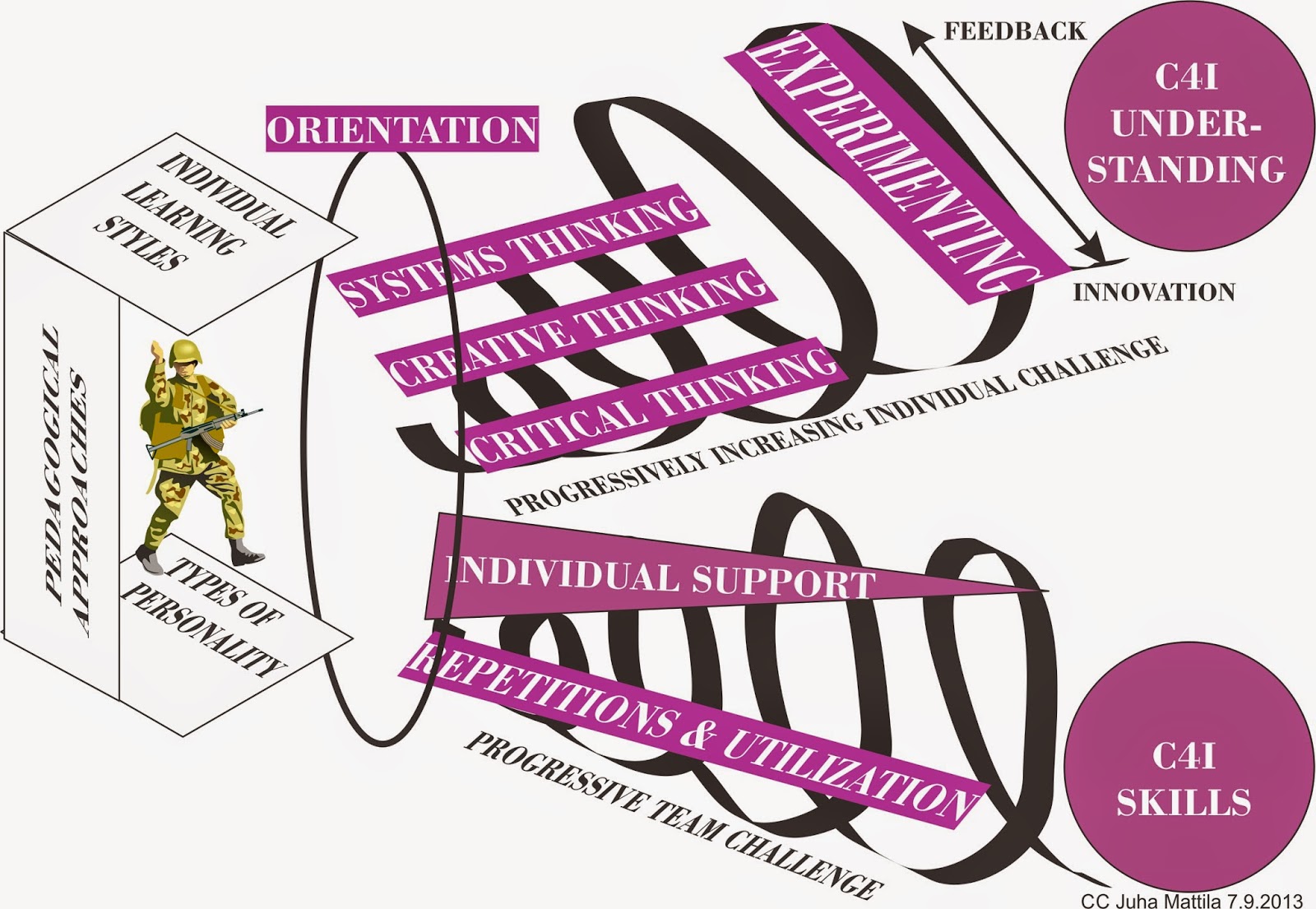
Following picture is describing a learning orientation model for Command, Control, Communications, Computers and Information (C4I) skills and understanding.


Figure 14: One orientation model for C4I understanding and skills training

Training of C4I soldiers starts always from individual. Training utilizes different pedagogical approaches adapted to individual learning styles and types of personality. Training has clear orientation structure that defines WHY coming skills and competence is needed. Deductive orientation also includes iterative introduction to features and countermeasures in C4I area of operation. Training for skills and understanding advance parallel and progressively providing possibilities for feedback, revisiting, extending further, digging deeper, room for innovation and mirroring with mentor.

C4I skills are learned mainly by team training with progressive challenges tailored to each team. Repetition is a discipline as a part of bigger system, but utilization of skills in different situations and environment is a driver for successful execution in progressively challenging environment. Although team is a unit in learning, individual support is very important during the first phases of instruction. According to individual maturity, support should be lessening as competence, innovation and teamwork are improving.

Training of C4I understanding is following Gartwright’s (2008) lines of educating soldiers rather how to think than what to think.  This means introducing a combination of three thinking methods: systems thinking, creative thinking and critical thinking. These thinking tools should be utilized along individually tailored path of learning towards C4I understanding. This learning path is a spiral with feedback from subordinates, peers and instructors. Spiral curve is accelerated by windows of opportunity to utilize innovative solutions but by providing safe environment for mistakes. Experimentation is main driver and pedagogical method in training for long lasting understanding of C4I tasks, systems and area of operation.

Learning C4I skills

C4I training should provide optimal support to learn team skills in a disciplinary way to ensure that fighting system of systems is operating effectively and persistently. C4I skills include:

  • Individual ability to operate and admin C4I devices, while sustaining in area of operation;
  • Team ability to accomplish more together as a part of C4I system when operating in C4I area of operation;
  • Co-operation ability of teams to provide services in disciplined way with complex C4I-system of systems in volatile and harsh environment.


To ensure individual and team function ability as a part of bigger entity and mainly in supportive position, training should be executed to standard. C4I standards should be defined from operations and exercises where fighting system of systems is being deployed. Mission-essential task list for C4I capabilities should be defined and systematically  projected to each C4I functions of individuals, teams and systems. This adjustment spiral should continuously analyse level of troops and balancing requirements coming from ever extending spectrum of operations. Analytical adjustment spiral  should provide C4I organizations with right cognitive framework and tangible measures, which have direct Impact on mission .

As any other military service or branch, C4I organizations should train as they fight. This means that training is done in team collective as soon as individual level is achieved. C4I troops operate the same system of systems but geographically separated. Co-operation in virtual world created by their C4I-system should be introduced early in their training. C4I teams work together with systems and other teams to provide services by following processes and driven by need of support of other arms and troops. C4I organizations should train always with some service to be provided to supportee in order to comprehend their interdependent role and be able to get pride from doing their support job well.

Since C4I organizations face opponent's effect directly in full spectrum of arsenal, their training conditions should include variants of environment, effects of opponent and changes of their supportee’s as gradually increased demands and problems closer resemblance of real world C4I area of operations includes. This demands skilful use of new training support methods like emulation, simulation and extended reality.
C4I teams should be trained to sustain spiritually, technically and functionally in harsh conditions, geographically separated from other troops, often attacked simultaneously by airborne weapons, electromagnetic waves and cyber measures. Spiritual sustenance requires team integrity that is built by close proximity with team members over 4 months of overcoming shared hardship, enjoying with shared achievements and sharing real world time with joys and sorrows.  Technical sustenance requires soldiers to feel responsibility of their systems, maintain, supply and update them in order to keep services available. This is achieved by delegating the technical ownership of their systems, signal sites and vehicles to each team. Technical sustenance should be measured throughout training and not only during short exercises.

Functional sustenance requires fulfilling the individual and team role in larger system of systems. This needs habitual and reasoned obedience expressed in virtual collective like signals platoon, company or battalion. It also requires responsibility to fulfil one's role while facing lethal environment without capability to counter it any other way but indirectly by providing C4I services to other troops.  To build this kind of discipline  and culture from inside rather than outside needs mentoring, historical role models, appreciation and direct rewarding when appearing. When sole human being is weak in facing fears of battle, these collective codes of conduct come to support and make soldiers to fulfil their duty.

Training should be gradually more demanding driving towards set standards. C4I organization may structure their training in incremental sprints  that consists learning phases  as follows:

  1. Orientation and basics,
  2. Function as system with repetition,
  3. Function as system of systems.

These sprints should be laminated over each other to ensure that mainstream training is based on increasingly familiar things. So each new subject or skill should be introduced via a sprint but in a coherent orientation framework. There should be different possibilities within sprint for each type of learning and personality to achieve most suitable learning path. Main exercise effort should be in application of C4I skills in different situations of facing effects of different variants of environment and opponent.
 

Learning Signals understanding

Signals understanding is leader’s and administrator’s ability to perceive their space of operation, teams and systems, other combat supporters, supportees and opponent as huge system where different parts interact with each other and with environment. It requires C4I soldiers to achieve synthesis  when processing towards understanding of this phenomena. C4I soldiers should reach the level of insight and foresight to be able to innovate and create best ways to deploy and operate one's C4I-system as interdependent part of fighting system of systems. Creativity is not enough since human behavioural weaknesses, but must be balanced with critical thinking and timely decision making. This understanding is needed from team leader level to highest C4I system, Chief Information Officer, Signals Commander or Head of J6 levels. Figure 15 tries to capture some features in Signals area of operation.


Figure 15: Signals and other C4I organization as part of bigger fighting system of systems in confrontation with similar chain of opponent's military force system.

Systems thinking  in Signals and C4I means soldiers ability to identify their signal system as structure of technical and human social subsystems that are interrelated with each other while supporting greater fighting system of systems when confronting opponent's effects and system of systems. Soldiers should be able to explain the behaviour and interrelations between the parts of C4I system and cause-effect interactions with environment. Soldiers should be able to explain their C4I system behaviour and interaction within fighting system of systems and when effected by opponent's fighting system. Learning this needs individually optimized teaching environment, team thinking and reflection. Since interrelationships are costly to experiment in real world, new training support methods may provide major increase in impact on mission. When teaching systems thinking one should be aware of the following human features:

  • Human being has tendency of thinking self-delusional and wishful while avoiding real world friction and unpleasant issues
  • One should focus on the purpose for which a system was created more than only processes and procedures of the system.
  • Simple use cases are not enough to achieve insight. One must experiment over time in seeking patterns and feedback loops to find rules of dynamics of a complex system.
  • Thinking should be focusing on synthesis over analysis – understanding whole over parts.
  • Leaders have a tendency to neglect systems thinking when in hurry, when they are focusing short-time goals or when their self-perception is too strong.
  • Technically oriented leaders have tendency to focus only technical system interrelations where as human oriented leaders might be more focused on social interrelations. Both approaches are needed in understanding C4I system of systems in its space of operation.

Creative thinking comes to use after capturing synthesis from systems thinking. There are many saying that creativity is not tolerated in hierarchical and paternalistic command and control system where constraints, discipline and supervision is typical. This is extremely distort perception of military leadership in Signals that is following guidelines of:

  • Approaching problem always from different scenarios and war gaming their possible out-come before deciding, which course of action should be taken as a best option to succeed in mission.
  • Including technical specialists and military generalists into planning process for better synthesis of whole situation and tactical options for signals
  • Learning continuously from lessons identified and especially capturing applicable ideas from those outside Signals business.
  • Making timely decision and bearing the responsibility of action in face of troops, commander, supportees and oneself.
  • Giving order in form of missions rather than tasks to give room for subordinate’s creativity, although securing that everyone dependent on synchronization is aware of changes.
  • Always thinking from opponent's point of view and not being unnecessarily evident in signals or C4I tactics.
  • Understanding that opponent's commanders are also creative beings and strive for surprise, capturing initiative and shaking their opponent's system of systems.

Creative thinking for Signals soldiers is best trained by solving a number of live world problems in simulated system of systems environment in co-operation with live stake holders. Virtual world should support collaboration between stake holders and these war game exercises should include different roles and role games to teach utilizing the diversity of people.

Critical thinking is supporting both systems and creative thinking tools in quest for Signals understanding. Every decision is based on assumptions – either known or non-aware. These assumptions must be recognised and critically studied, while implementing current decision. A side with implementing a plan, parallel optional plans should be produced to accelerate Command and Control process. When environment or opponent is not behaving in assumed way, leader must be able to reconsider earlier decisions and either adjust ongoing plan or replace it with more suitable plan. Here leaders should be aware of their natural tendency to have egocentric memory that forgets information that does not support adapted intent. Human being tends also to narrow one's thinking point of view with time and stress. As self-esteem improves there appears a tendency to feel superior based on own belief's rather than real world incidents. In the end human decision maker has a tendency not to notice facts or evidence contradicting one's beliefs or values.

Critical thinking skills are best developed in training by:

  • Providing knowledge from a multidisciplinary perspective about critical thinking skills by providing legends of different tactical decisions and their outcomes,
  • Practicing the recognition of assumptions in C4I and Signals context and environment
  • Reflecting situation in every debriefing from egocentric approach in dialogue  with peers or with instructor that may play role of “devil’s advocate”.

Together with C4I understanding leaders should have ability for timely decision making. There are many disadvantages in leaders, but major faults have been lack of decisiveness or integrity and inability to communicate.  Signals leader should first formulate an intention of how C4I services will be supporting other troops and fighting system of systems. This intention should be communicated to all service providers within the value chain of signals as well as to supportees. Signals intention serves as a guide line for mission command, a reason for team’s efforts and a promise of service for supported troops. Other fragmentation decisions and orders may follow this initial decision, when needed to synchronize C4I system of systems operation.

Decision making is trained by making decisions and reflecting their outcomes. Taylor and Gollwitzer   (1995) discovered that even in temporarily state of neuroticism, low sense of control or pessimism, it is better to make any decision and start implementing it. This will produce feeling of confidence and capability which further improves humans feeling of decisiveness. Similar approach for timely made decision was utilized in German officer training before WW II.

Decision making exercises should include trial – error – learning loops that enable leaders and soldiers to understand the causality of their decisions and give opportunities to learn from them. A sign of high level signals leader is that he learns from his mistakes, owns his failures and their outcomes, remedies and rectifies unwanted outcomes and puts safeguards in place to prevent their recurrence.

Continuous improvement
Since all Signals and C4I organizations skills and understanding is relative to opponent’s capabilities and depends on changing environment, technology and supportees, there are no fixed goals but continuous learning of new skills and understanding within C4I organizations. This is achieved by following LEAN principles of continuous improvement and Capability Maturity Model (CMM) to define performance of processes through organizations.

LEAN  development is developed by Taiichi Ohno in Toyota to get rid of muda, ‘waste’ that any human activity has tendency to build around functions within time. This waste absorbs resources but creates no value. Lean thinking requires to define value, stream, flow, pull and establish continuous perfection. Value is reason for existence. It is the information and services Signals is producing to other services. Then one has to understand the value stream, which is a set of specific actions required to produce C4I service. Flow includes all necessary functions and organization that is needed to produce C4I services. There is a pull of need coming from actual end users and supported organizations. Lastly there is the continuous perfection, where users pull value as continuous flow through the whole value stream. Measures should be attached along this model to give direct feedback both for operators and leaders to improve their production, protection and maintenance of C4I services.

With Capability Maturity Model  Signals and C4I organizations are understanding how their service providing and managing processes are maturing step by step. Since Signals and other C4I organizations are producing value mainly with processes, it is important to understand how the culture of man-machine-process system matures through following steps:

  1. “Initial (chaotic, ad hoc, individual heroics) - the starting point for use of a new or undocumented repeat process.
  2. Repeatable - the process is at least documented in way that repeating the same steps may be attempted.
  3. Defined - the process is defined/confirmed as a standard business process, and decomposed to levels 0, 1 and 2 (the last being Work Instructions).
  4. Managed - the process is quantitatively managed in accordance with agreed-upon metrics.
  5. Optimizing - process management includes deliberate process optimization/improvement.” 

Together with understanding of process culture maturity and of continuous improvement of value creating, Signals and C4I organizations keep up with opponent’s countermeasures, changing environment and demanding client.

Continuous exercising of BLUE – RED struggle
Since military C4I structures are mainly isolated from every day attacks of Internet, they are living in peace behind high perimeter Firewalls and air gaps. Within their digital fortifications there are only well behaving end users and very clandestine opponents. Signals and C4I service production organizations do not get practice enough to improve their skills and understanding. Thus cyber exercises are normal routine in digital environment. Opponent’s behaviour and deeds are simulated by Red teams  that execute advanced attacks, physical destruction and electromagnetic effects. These controlled event provide C4I personnel needed stimulus to cooperate and learn to achieve better in difficult situations.

Since no one can defend successfully alone for long in digital environment, national exercises should be introduced to improve cooperation between organizations security operations, national CERT agencies, information service providers, application service providers and communication service providers. These exercises should be executed both as wargaming and practical domain defence way.

National exercises are not enough, but C4I crews are to participate also International exercises, where, in cooperation with other nations, sharing of experiences and practicing innovative attacks and improving defensive tactics happens. These exercises are for example:

  • Multinational Experiment (MNE) which is both operations and C4I concept development experimentation to improve international peace and stability operations capabilities. 
  • NATO Coalition Warrior Interoperability exploration, experimentation, examination exercise (CWIX) is annual exercise where multinational C4I systems, processes and competence is exercised as larger entity including cyber attack and defence. 
  • USEUCOM/NATO Combined Endeavour (CE) is the largest command, control, communications and computers interoperability event in the world. In event hundreds of C4I professionals conduct series of operationally-focused interoperability tests to achieve multinational interoperability required in ongoing and future operations.  There is also Cyber Endeavour which is professional seminar in tactical level cyber defence and offence.
  • NATO Cooperative Cyber Defence, Centre of Excellence arranges annual Locked Shields real-time network defence exercise. 


Conclusion

Although military often has several separate ICT domains that are even separated from each other with air gap at network level, there are other means for avenues of attacks. Insiders, social networks, electricity, conduction of electromagnetic fields, kinetic effect in physical dimension, supply of SW or HW, etc.  This exposes military ICT structures to three classical vulnerabilities of fortifications: enemy is already inside, enemy is beating you by destroying your logistics or adversary is using dimension that is outside of defenders imagination.

When planning and preparing for confrontation in digitized environment, one should see beyond systems and cyber to whole digitized global entity with strong social networks and several other connections that opponent may use as avenue of attack.

In military operations, cyber is only a part of whole picture although one of the newest dimensions in area of operations. Focusing mainly to cyber dimension and contemporary crises, one may reach only partial or narrow conclusions.

To be able to defend oneself successfully, one needs to understand opponent’s strategy, operational possibilities and tactical means. Defence is always defined to protect valuable assets against most threatening attacks. Otherwise there is a tendency to try to protect everything and end up protecting nothing, since defence is spread too thinly.

If threat in public Internet has evolved from experimental hackering of early days to professional criminals trying to steal valuable information and states and large organizations to gain advantages, military rationale is to wage information operations, prepare for other means of attacks and shock and awe in the very beginning of operation.

Human being and its trust is still main target for opponent that is planning cost-effective operations. Analysing owns trust-structure will expose most valuable targets of one’s opponent but also center of gravity that should be protected. Planning attack is also part of planning defence.

In military digital environment method of protecting and securing assets is evolving from building domain perimeter security measures towards installing firewalls on every host in domain and monitoring all behaviour between hosts. Successful defence demands quick reaction forces to take down malevolent processes, which means tighter integration between all ICT service provider organizations and their support chain.
As complexity, velocity and volume of digital domains increases, it becomes hard to detect anomalies. Depth of defence is built by improving intelligence, building multilevel protection and adding depth between possible avenues of advance and most valued assets.

Even though big data analysis is improving sense making, there is a need to be a part of society of other defenders to learn quicker from other’s mistakes and experiences. Versatility of attacks is increasing and it is impossible for any one organization to be sufficient at all levels of technology and their possible malevolent exploitation.

Reactive defence does not produce advantage over attacker, but more proactive measures must be utilized. This may begin with vulnerability testing and hardening but go further to design more defendable ICT system structures. There are also self-healing functions and software defined security available to modify digital environment friendlier for defence.

Since command and control of security and ICT operations become essential for defence, it also becomes one of the main targets for opponent. Management system is attacked both cyber, physical, electromagnetic and psychological means. Protection against these measures should be defined according mission and space of operation specific analysis.

If one builds defence capabilities mainly based on programmed automatic executed by machines, it becomes itself a vulnerability that opponent may exploit. There is a need of high skilled and knowledgeable people and processes that integrate people’s deeds together in defence of digitalized environment. As automated machines also automated people are vulnerability so focus should be also in understanding and situational based behaviour.

It takes lot of training and exercises to build mature skills and understanding. It also requires to enable people to confront different situations and different ideas to continuously improve their skills. Defence capability in digitalized environment is relative to opponents capabilities thus right intelligence and scenario analyses is needed to build protection to sufficient level.